That persistent ache in your elbow might have a surprising source: the muscles on the back of your arm. Weak triceps can absolutely contribute to pain by reducing elbow joint stability and forcing smaller muscles to work overtime. The good news? You can rebuild that strength and finally get some relief.
Physical therapy gives you a clear, safe path forward. At Ivy Rehab, our therapists help you restore strength, improve coordination, and move with confidence again. This guide breaks down how your triceps and elbow are connected and how PT helps you get back to feeling strong.
How Triceps Weakness Affects Elbow Health
Your triceps straighten your arm and help steady the elbow during everything from pushing open a door to carrying groceries. When your upper-arm muscles are weak, your body leans on smaller forearm muscles and tendons to pick up the slack. That compensation creates extra tension and irritation around the elbow tendon.
An imbalance between your biceps and the muscles on the back of your arm can make this worse, especially if you sit with rounded shoulders, repeat the same motion at work, or are recovering from an injury. So the answer to “can weak triceps cause elbow pain?” is yes — and understanding the reason behind it is the first step in turning things around.
Common Signs of Triceps-Related Elbow Pain
You might be dealing with triceps-related elbow pain if you notice:
- Pain at the back of the elbow when pushing, lifting, or extending your arm
- A heavy or fatigued feeling during workouts
- Soreness and tenderness when pressing on the back of the elbow
- Trouble keeping your arm steady during movements like push-ups, dips, or throwing
Weakness often develops slowly, so these early signals matter.
Causes of Triceps Weakness
Your triceps can lose strength for many reasons. Pinpointing the cause helps your physical therapist build a focused treatment plan.
Common causes include:
- Lack of strength training: Not enough pushing exercises in your routine
- Repetitive strain: Overuse from sports or work, often linked to triceps tendonitis, also known as weightlifter’s elbow
- Poor shoulder mechanics: Weak or unstable shoulder blades can change how your arm moves
- Nerve irritation: Issues in the neck that affect triceps activation
- Post-surgical recovery: Immobilization or healing time naturally reduces strength
No matter the cause, a physical therapist can help retrain the muscle and restore balance.
How Physical Therapy Restores Triceps Strength and Relieves Elbow Pain
PT gives you a full picture of what’s driving your pain. Once your therapist identifies how your triceps are involved, they build a plan that strengthens your entire arm, corrects movement patterns, and protects the elbow.
Manual Therapy & Soft Tissue Work
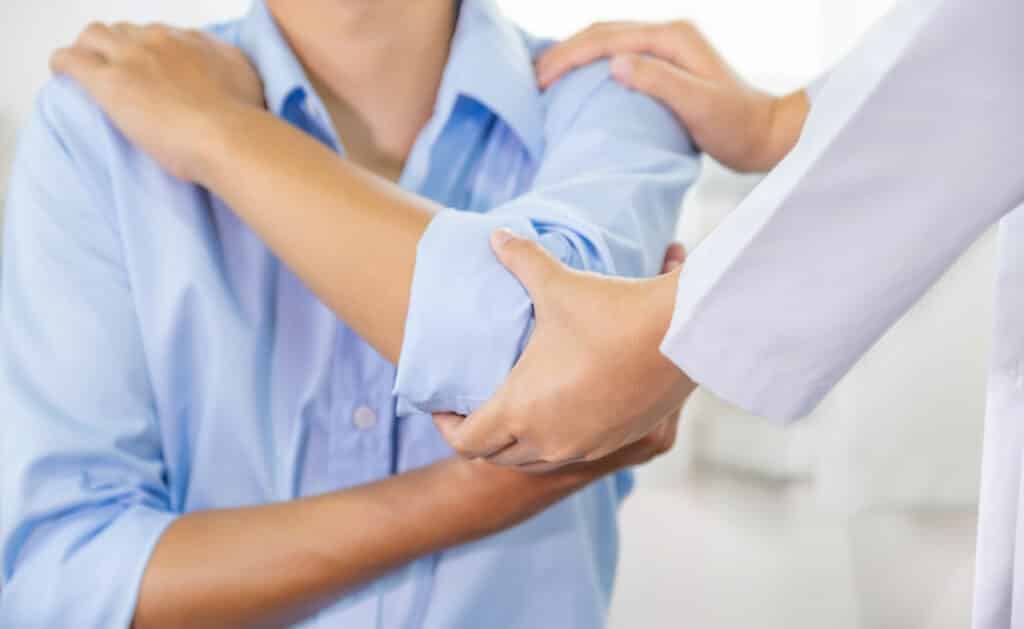
Hands-on care helps calm irritation, reduce soreness, and improve mobility. Your therapist may use soft tissue techniques to loosen tight forearm muscles, reduce inflammation, and prepare the area for strengthening.
Targeted Strengthening Exercises
This is where the change really happens. You’ll work on your triceps, shoulders, and forearm stabilizers so your elbow has the muscular support it needs. The goal is to help your arm function as one coordinated unit.
Posture and Movement Training
How you hold and use your body matters. Your PT will help you clean up habits that place extra stress on the elbow joint. Better alignment equals less strain and supports long-term mobility.
Progressive Loading Programs
True strength builds gradually. Your therapist will help you increase load in a way that feels challenging but safe, which is especially important for triceps tendonitis rehabilitation. This step helps you regain power and prevent future flare-ups.

PT Exercises to Strengthen Triceps and Reduce Elbow Pain
These exercises are commonly used in clinics and are helpful when done under the guidance of a physical therapist. Stop if you feel any sharp pain or discomfort.
1. Isometric Elbow Extensions
Bend your elbow to 90 degrees. Use your opposite hand to gently resist as you try to straighten your arm. Hold for 5–10 seconds. Repeat 10 times.
2. Triceps Kickbacks (Light Resistance)
Hinge forward at the hips, keep your back flat, and hold a light weight. Tuck your elbow in, straighten your arm behind you, then slowly return. Aim for 3 sets of 12–15 reps.
3. Wall or Table Push-Ups
Place your hands on a wall or elevated surface. Lower your body with control, then push back up. This builds strength without overloading the elbow.
4. Overhead Triceps Stretch
Reach one arm overhead, bend your elbow, and gently pull with the opposite hand. Hold 20–30 seconds.
Recover Faster, Perform Better
Discover how Ivy Rehab can help you achieve your therapy goals.
When to Seek PT for Elbow Pain or Triceps Weakness
It’s time to see a physical therapist if:
- The pain sticks around despite rest
- Weakness affects your everyday movements
- Pushing or lifting creates discomfort
- You’ve dealt with recurring elbow or shoulder strain
Early care helps you recover faster and avoid chronic irritation.
Why Choose Ivy Rehab for Elbow Pain Treatment
At Ivy Rehab, we focus on getting to the root of your pain, not just chasing symptoms. You’ll work one-on-one with an orthopedic physical therapist who combines manual therapy, strength training, and movement retraining to help you feel better and stay better. We make sure you understand your body and walk away with tools you can use for life.
Build Your Strength, Leave Pain Behind
Weak triceps can absolutely influence elbow pain, but with the right support, you can rebuild strength and move without hesitation. PT helps restore balance, ease strain, and bring confidence back into your daily life.
Ready to make a power move? Find an Ivy Rehab near you and schedule an evaluation with our team today.
References
- Diagnosis and treatment of triceps tendon injuries: a review of the literature— National Library of Medicine
https://pubmed.ncbi.nlm.nih.gov/24157465/ - Mayo Clinic — Tennis Elbow (Lateral Epicondylitis) (helps explain compensatory mechanics relevant to triceps weakness)
https://www.mayoclinic.org/diseases-conditions/tennis-elbow/symptoms-causes/syc-20351987

Before you go
Find the right therapy today.
Discover how Ivy Rehab can help you get back to doing what you love.