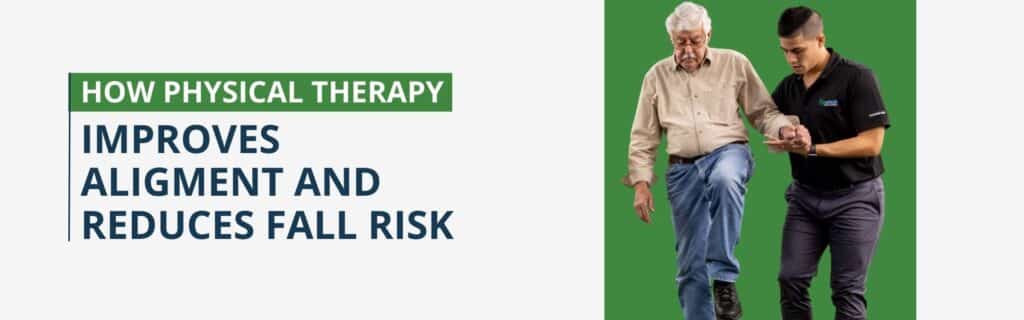
If you’ve ever caught your reflection and thought, “When did my shoulders start rounding forward?” you’re not alone. Posture changes sneak up slowly. A little slouch at the desk, a phone tilted too long, or an old injury that never quite healed. Before you know it, your body’s center of gravity starts to shift.
That small shift can have a big impact. It changes how you move, how steady you feel, even how confident you are taking that last step off the curb. But here’s the good news: you can retrain your body to move the way it was meant to – strong, balanced, and steady.
Rehabilitation physical therapy for posture correction helps restore alignment and rebuild stability, so every step feels more natural again. At Ivy Rehab, we start where you are and help you move forward with confidence.
Why Posture and Alignment Matter for Fall Risk
Posture is your body’s blueprint for balance. When you stand in alignment — head over shoulders, shoulders over hips — your muscles work together the way they’re meant to. Everything stacks neatly, and movement feels effortless.
When posture breaks down, your body starts compensating. A tilted pelvis or rounded back throws weight forward, forcing smaller muscles to do bigger jobs. That means fatigue sets in faster, reaction times slow down, and falls become more likely.
Studies have found that age-related postural changes – especially increased forward trunk tilt and thoracic curvature – are strongly linked with slower walking speed and reduced balance recovery after a stumble (BMC Musculoskeletal Disorders, 2023).
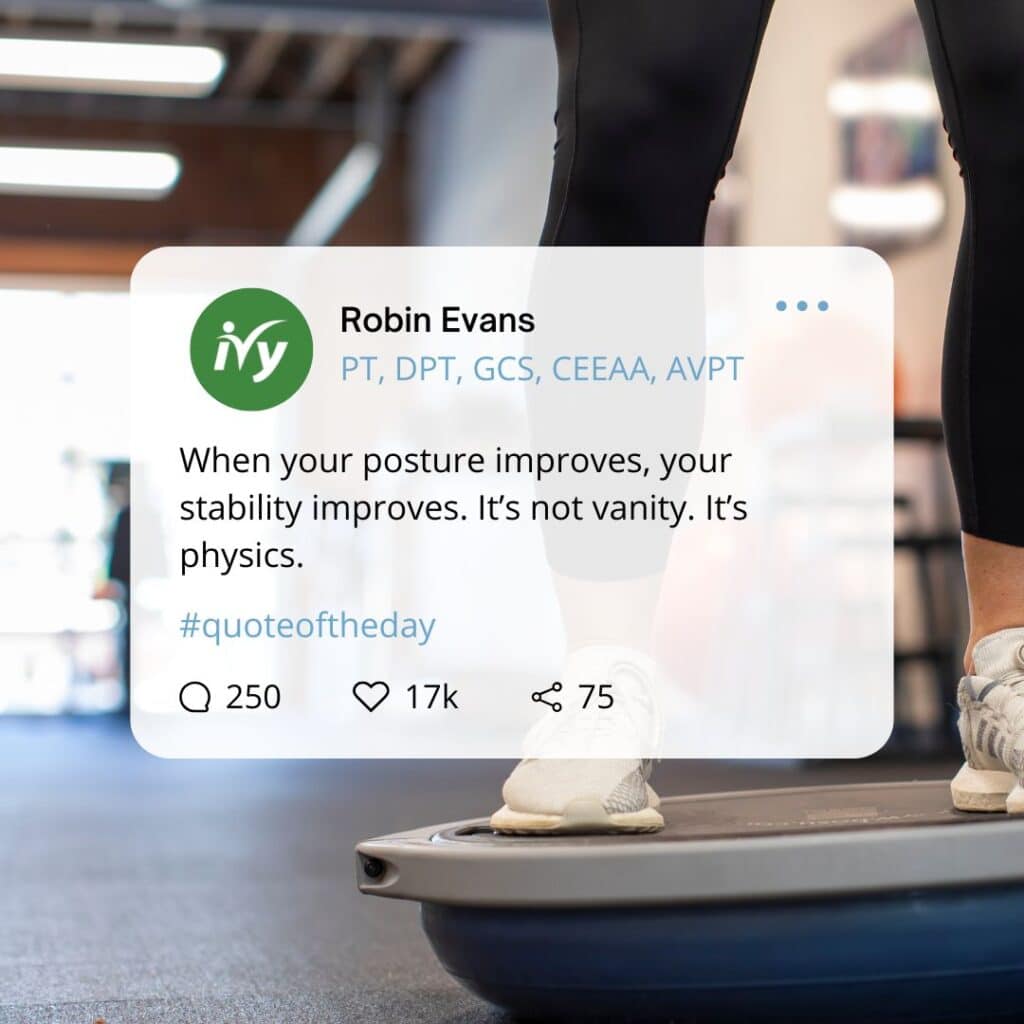
In fact, research shows that postural alignment directly affects balance and fall risk in older adults (Innovative Aging, 2020). As Robin Evans, Ivy Rehab’s Director of Geriatric & Vestibular Specialty Programs, puts it: “When your posture improves, your stability improves. It’s not vanity. It’s physics. Good alignment keeps you ready for whatever the world throws your way.”
Signs of Poor Posture and Alignment Issues
The signs of poor posture are easy to overlook because they happen gradually:
- Rounded shoulders or a slight hunch in the upper back
- Forward head position (“tech neck”)
- One side of the body carrying more weight
- Frequent stiffness or aches in the neck or back
- Feeling off-balance or uneasy on uneven ground
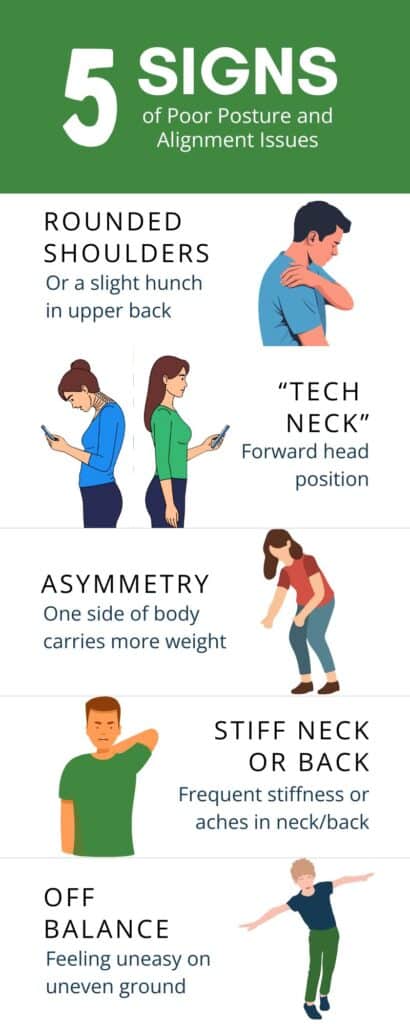
Research shows that people often underestimate these small posture shifts until they begin affecting balance confidence – what clinicians call “postural control self-efficacy” – a key predictor of fall risk (BMC Geriatrics, 2024).
Catching these cues early helps prevent bigger issues down the road, especially falls, which are often the first sign that posture and balance are working against each other.
PT-Approved Posture and Alignment Exercises
Improving posture isn’t about forcing your body into perfect form. It’s about retraining the muscles that hold you there. Physical therapists use the best exercises for posture to help your body find strength, balance, and awareness again.
Here are some examples you might see in a typical program:
1. Chin Tucks
- How to: Sit or stand tall. Gently draw your chin straight back, keeping your head level.
- Hold: 3–5 seconds | Reps: 10–15 | Sets: 2–3
- Why it works: Strengthens neck stabilizers and reverses forward-head posture.
2. Shoulder Blade Squeezes
- How to: Pull your shoulder blades down and together. Avoid shrugging.
- Hold: 5 seconds | Reps: 10–12 | Sets: 2
- Why it works: Builds upper back endurance for upright posture and easier breathing.
3. Wall Angels
- How to: Stand with your back, head, and wrists against a wall. Slowly raise and lower arms in a “snow angel” motion.
- Hold: 1–2 seconds | Reps: 8–10 | Sets: 2
- Why it works: Improves shoulder mobility and posture awareness.
4. Pelvic Tilts
- How to: Lie on your back, knees bent. Gently flatten your lower back into the floor, then release.
- Hold: 5 seconds | Reps: 10–12 | Sets: 2–3
- Why it works: Strengthens deep core muscles that stabilize the spine.
5. Seated Posture Training
- How to: Sit tall with shoulders relaxed and feet flat. Imagine lengthening your spine toward the ceiling.
- Hold: 10–15 seconds | Reps: 5–8 times throughout the day
- Why it works: Reinforces awareness during everyday activities.
6. Heel-to-Toe Walks
- How to: Walk in a straight line, placing the heel of one foot directly in front of the toes of the other.
- Duration: 10–20 steps | Sets: 2–3
- Why it works: Strengthens the connection between posture and balance while improving coordination.
Clinical reviews show that targeted postural and balance exercises like these significantly improve trunk control and gait stability in adults over 60. This is especially true when paired with supervised physical therapy (PLOS One, 2022).
These posture and balance exercises are great starting points, but your physical therapist will tailor the plan based on your comfort, strength, and goals.
How PT Improves Alignment and Prevents Falls
Physical therapy rebuilds how your body moves through space. A good physical therapy plan looks at the whole picture: strength, coordination, and the small habits that keep you stable.
Strengthening Weak Muscles
Therapists focus on the core, hips, and upper back — the pillars of alignment. As these muscles strengthen, they take pressure off smaller joints, improve posture, and make balance feel natural again.
Research supports that trunk and hip strengthening improves “anticipatory postural adjustments” (your body’s ability to brace before movement), which plays a key role in preventing falls (Frontiers in Neurology, 2022).
Balance and Gait Training
Using controlled challenges like stepping over obstacles, walking on uneven surfaces, or practicing turns, physical therapy helps your body adapt to the real-world moments that often cause falls.
Posture Awareness Education
“Posture isn’t something you fix once,” says Robin Evans. “It’s something you learn to feel — and correct — in real time.”
That’s why physical therapy includes posture retraining for everyday life: carrying groceries, gardening, getting up from a chair, or using stairs safely.
In fact, awareness training that integrates visual, vestibular, and proprioceptive cues (a technique often used by Ivy Rehab therapists) has shown to improve functional balance and reduce fall risk even in high-risk groups (Frontiers in Aging Neuroscience, 2017).
Benefits of Posture and Alignment Training
When alignment improves, life feels easier. You move more efficiently, get less tired, and feel more confident in every step.
The benefits include:
- Reduced risk of falls and injuries
- Better balance, flexibility, and coordination
- Less strain and pain in the back and neck
- Improved mobility and independence
- Renewed confidence in movement
Posture-focused physical therapy helps your body move as a single, coordinated system. When your strength, flexibility, and balance are working together, stability becomes second nature, and daily activities start to feel easier again.
Maintain Independence and Mobility
Specialized programs focusing on balance, strength, and fall prevention.
Why Choose Ivy Rehab for Posture & Fall Prevention
At Ivy Rehab, we know that every posture tells a story — of resilience, age, experience, and growth. That’s why our therapists build our balance & fall prevention programs that meet you where you are, using evidence-based physical therapy and one-on-one guidance to get you back to feeling balanced and strong.
“We help patients find their footing again — literally,” says Evans. “Once you start moving with better alignment, confidence follows.”
Whether you’re recovering from surgery, managing a chronic condition, or just trying to move through life with a little more ease, Ivy Rehab’s physical therapists are ready to help you take that first steady step forward.
Conclusion
Alignment and balance go hand in hand. When one improves, so does the other. With the right exercises, expert guidance, and a personalized plan, physical therapy can help you move taller, steadier, and more confidently. At Ivy Rehab, we specialize in posture and balance exercises that improve alignment, reduce fall risk, and help you move confidently at any age.
Find an Ivy Rehab clinic near you and start your posture and balance journey today.

Before you go
Find the right therapy today.
Discover how Ivy Rehab can help you get back to doing what you love.