
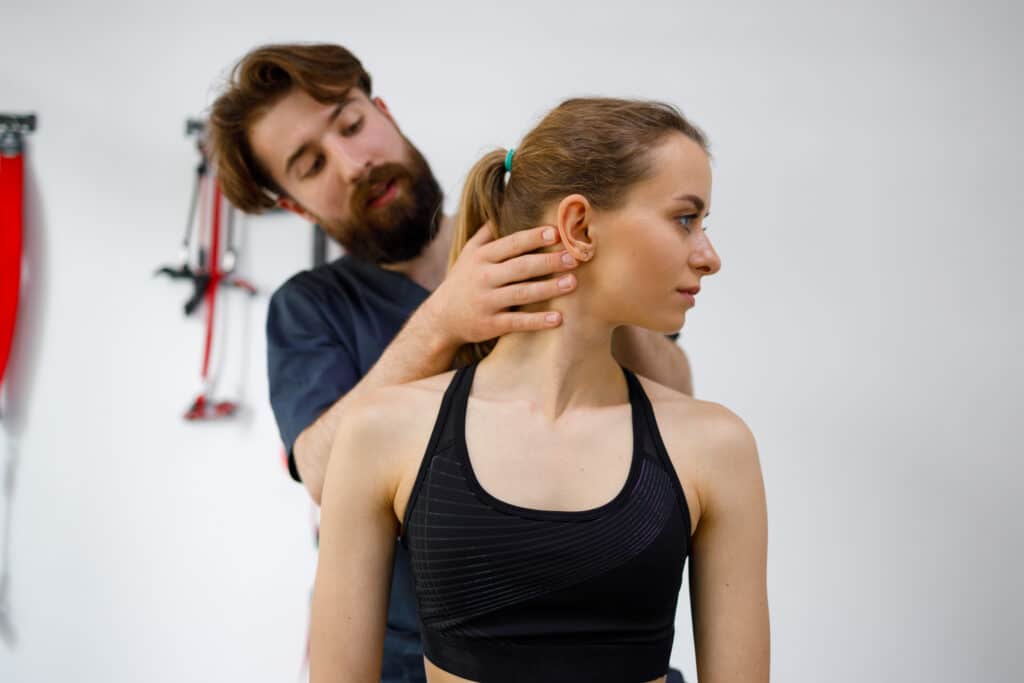
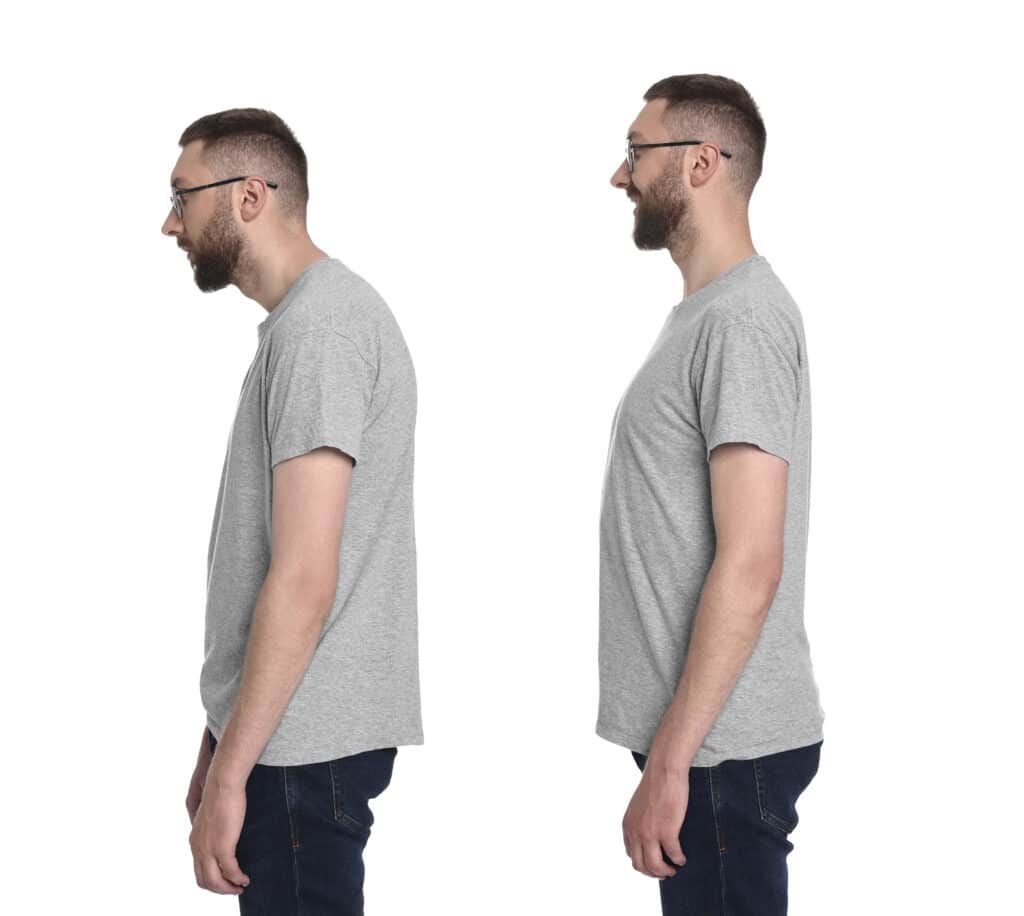
Forward head posture occurs when your head sits in front of your shoulders rather than resting on your neck and upper back. It can strain the neck muscles, pull the shoulder blades forward, and make the upper back work harder than it should.
The extra strain can add up fast. A spine-modeling paper on head and neck position estimated that the head exerts about 10 to 12 pounds of force on the cervical spine in a neutral position, compared with about 27 pounds at a 15-degree forward tilt and 40 pounds at a 30-degree forward tilt.
Forward head posture exercises can help by retraining the muscles that support your head, neck, and upper back. The right plan uses chin tucks, upper back strengthening exercises, chest stretches, and workstation changes to support better posture without forcing your neck into a stiff position.
Key Takeaways
- Forward head posture can add strain to the cervical spine, neck muscles, upper back, and shoulder blades.
- The best forward head posture exercises usually combine chin tucks, upper back strengthening, and chest stretches.
- Corrective exercise should feel controlled, not sharp or forced.
- Rounded shoulders, slouching, text neck, and low screen position can keep recreating the same neck posture during the day.
- Physical therapy can help if neck pain, headaches, back pain, or range of motion limits keep coming back.
Quick Navigation
- What Causes Forward Head Posture?
- How Forward Head Posture Affects the Neck and Upper Back
- Forward Head Posture Exercises to Try
- Workstation and Phone Posture Tips
What Causes Forward Head Posture?
Forward head posture usually develops from repeatedly holding several positions, not from one bad posture. It often builds when your head stays tipped forward while working at a desk, reading, driving, or using your cell phone.
Slouching can also start lower in the body. When the lower back rounds or the upper back leans forward, the head often follows, keeping your eyes level.
Common contributors include:
- Screens that are below eye level.
- Phone use with the head tipped down.
- Rounded shoulders and tight chest muscles.
- Weak deep neck flexors, rhomboids, and other postural muscles.
- A keyboard that’s too far away or a chair that doesn’t support the lower back.
You don’t have to have perfect posture all day. You need to give your neck, upper back, and shoulder blades better support so they return to the neutral position more easily.
How Forward Head Posture Affects the Neck and Upper Back
When the head is leaning forward, the neck and back muscles have to work harder to hold it up. Muscles such as the upper trapezius, levator scapulae, and small suboccipital muscles at the base of the skull may feel tight or overworked.
Forward head posture can also change how the thoracic spine, chest, and shoulder blades move. That’s why neck posture is often connected to rounded shoulders, upper back stiffness, headaches, and pain between the shoulder blades.
Some people also notice headaches that start near the base of the skull, jaw tension, or discomfort in the temporomandibular joint (TMJ). These symptoms can have several causes, so get checked by a healthcare professional if they keep coming back.

Forward Head Posture Exercises to Try
Forward head posture exercises should feel gentle and controlled. Start with a small range of motion, move slowly, and stop if pain increases or symptoms travel into your arm or hand.
Research supports an active approach. A systematic review found that therapeutic exercise may improve forward head posture and neck pain, especially when the plan targets the neck and upper back.
Chin Tuck
Start sitting or standing tall and look straight ahead. Glide your chin straight backward, as if making a small double chin, without looking down. Hold for three to five seconds, then relax.
Start with eight to 10 reps, and make the movement smaller if the sternocleidomastoid muscles at the front and sides of your neck grip hard. Chin tucks bring the head closer to neutral and help train the deep neck flexors.
Shoulder Blade Squeeze
Start with your arms relaxed at your sides. Gently draw your shoulder blades back and slightly down, then release.
This helps the rhomboids and other back muscles support the upper back without shrugging toward your ears.
Wall Angels
Stand with your back near a wall and your feet a few inches away. If it feels comfortable, let the back of your head, shoulder blades, and lower back rest against the wall. Raise your arms into a W shape, then slowly slide them upward and back down.
Use a smaller range if your shoulders or neck feel strained. Wall angels work on shoulder blade control, chest mobility, and thoracic spine position.
Doorway Chest Stretch
Stand in a doorway with your forearms on the frame. Step one foot forward until you feel a mild stretch across the chest muscles. Hold for 20 to 30 seconds, and keep the stretch gentle.
This stretch helps reduce chest muscle tightness. Tight chest muscles can pull the shoulders forward, making posture correction harder.
Thoracic Extension Over a Chair
Sit with the top of the chair back at your mid-back. Support your head with your hands, gently lean your upper back over the chair, then return to the starting position.
Try five to eight slow reps, and stop if it increases pain. This helps the upper and mid-back extend, making it easier to correct poor posture.
Workstation and Phone Posture Tips
Exercise helps, but daily habits are also important and can make a big difference. If your workstation or phone habits keep pulling your head forward, your neck has to continue fighting the same position.
Ergonomic changes can help reduce strain during the day, including:
- Raising your monitor so the top third of the screen is near eye level.
- Bringing your keyboard and mouse close enough that your elbows stay near your body.
- Supporting your lower back so your upper back doesn’t have to round forward.
- Holding your smartphone closer to eye level during longer text conversations.
- Taking short movement breaks every 30 to 45 minutes.
Small changes are easier to repeat. That matters more than one perfect setup you can only tolerate for five minutes.
Ivy Rehab Therapy’s physical therapy for neck pain, headache treatment, and physical therapy services can help when pain relief, range of motion, or better posture is hard to manage on your own.
FAQs
Is Text Neck the Same as Forward Head Posture?
Text neck, also called tech neck or nerd neck, refers to neck strain from looking down at phones, tablets, or laptops. Forward head posture is a general term for the head resting in front of the shoulders rather than over the upper back. Screen habits can contribute, but desk setup, driving, reading, rounded shoulders, and upper back stiffness can also play a role.
What Is the Best Exercise for Forward Head Posture?
Chin tucks are one of the most common starting exercises because they target the deep neck flexors and help bring the head toward a neutral position. Most people also need upper back strengthening and chest mobility work, so the neck isn’t doing the whole job on its own.
When Should I See a Physical Therapist?
Consider physical therapy if forward head posture exercises aren’t helping enough, neck pain keeps returning, headaches are more frequent, or you have pain, numbness, or tingling in the arm or hand. A physical therapist can check strength, mobility, workstation habits, and movement patterns.
Talk to a Physical Therapist About Neck Posture
Forward head posture usually doesn’t improve because you try to sit up straight all day. It improves when the right muscles get stronger, and your daily setup stops pulling your head forward.
Find an Ivy Rehab Therapy location near you if neck posture, upper back tension, or screen-related neck pain is making daily activities harder. A physical therapist can develop a plan to improve posture and make movement more comfortable.
Key Terms
Text neck: A common term for neck strain or forward head posture linked to looking down at phones, tablets, laptops, or other screens.
Forward head posture (FHP): A posture pattern where the head rests in front of the shoulders instead of over the upper back and cervical spine.
Deep neck flexors: Small neck muscles at the front of the cervical spine that help hold the head in a neutral position.
Rounded shoulders: A posture pattern where the shoulders rest forward instead of staying more open across the chest.
References
- Assessment of Stresses in the Cervical Spine Caused by Posture and Position of the Head. Surgical Technology International. Accessed March 2026. https://esq.h-cdn.co/assets/cm/15/07/54d948b56d7d7_-_spine-study.pdf
- Effect of Neck Exercise on Sitting Posture in Patients With Chronic Neck Pain. Physical Therapy. Accessed March 2026. https://academic.oup.com/ptj/article-abstract/87/4/408/2742122
- Effectiveness of Therapeutic Exercise on Forward Head Posture: A Systematic Review and Meta-analysis. Journal of Manipulative and Physiological Therapeutics. Accessed March 2026. https://pure.ul.ie/en/publications/effectiveness-of-therapeutic-exercise-on-forward-head-posture-a-s/
- The Relationship Between Forward Head Posture and Neck Pain: A Systematic Review and Meta-analysis. Current Reviews in Musculoskeletal Medicine. Accessed March 2026. https://link.springer.com/article/10.1007/s12178-019-09594-y
- Physical Therapy Guide to Neck Pain. ChoosePT. Accessed March 2026. https://www.choosept.com/guide/physical-therapy-guide-neck-pain
- Physical Therapy Guide to Temporomandibular Disorder. ChoosePT. Accessed March 2026. https://www.choosept.com/guide/physical-therapy-guide-temporomandibular-joint-disorder

Before you go
Find the right therapy today.
Discover how Ivy Rehab can help you get back to doing what you love.