Soccer players aren’t exactly famous for enjoying the sideline, and Cayden Tadros is no exception.
He plays center midfield, attends Michigan State, and competes in the semiprofessional MWPL during the summer. Then, during a game, one play changed the plan: Cayden tore his medial collateral ligament (MCL) and posterior cruciate ligament (PCL).
Suddenly, soccer injury recovery wasn’t something happening to somebody else. His season, his knee, and his path back onto the field were all on the line.
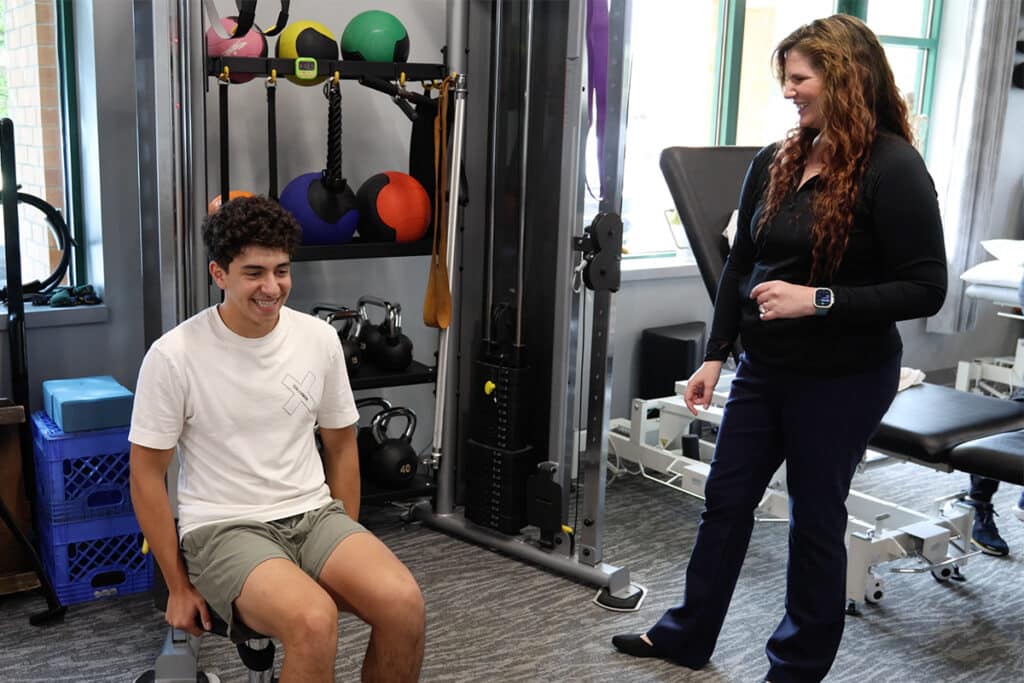
Four weeks into physical therapy at Ivy Rehab Physical Therapy in Brighton, Michigan, Cayden could already see how far he’d come. But his story isn’t really about recovering fast. It’s about learning something every athlete eventually must face: getting back isn’t the same as being ready to get back.
From Midfield to Physical Therapy
When Cayden started this round of physical therapy, something as basic as straightening his leg wasn’t so basic anymore.
“I could not straighten my knee,” he says. “It was stuck.”
Cayden remembers being told that his knee was roughly 35 degrees from fully straight. For an athlete used to running, cutting, changing direction, and covering the middle of a soccer field, that’s a pretty significant change in job description.
So the early goal wasn’t glamorous. No game-winning goal. No dramatic sprint down the field. Straighten the knee. Then build from there.
That kind of progression is a core part of athletic therapy at Ivy Rehab Physical Therapy, where treatment can move from restoring mobility and strength toward activity-specific training as an athlete improves.
From Stuck to Strength
About four weeks after beginning treatment for this injury, Cayden says he’d gone from struggling to straighten his knee to getting it “almost straight.” Then came the next phase: strength and conditioning.
“I’ve seen a massive improvement,” he says.
That’s the kind of progress athletes notice. Range of motion starts coming back. Strength work enters the picture. What had felt out of reach a few weeks earlier was starting to come back into view.
For Cayden, that progress has happened quickly. He says he’d originally expected this stage of recovery to take closer to two months. That’s encouraging, but it’s also where the temptation to turn recovery into a race can sneak in.
Fast Is Nice. Ready Is Better.
Athletes understand clocks: game clocks, shot clocks, personal bests, split times, and, in soccer, those strangely elastic minutes known as stoppage time. Recovery, however, is a terrible place to add another one.
A calendar can tell you how long it’s been since an injury. It can’t tell you whether a knee is ready to cut, accelerate, decelerate, or handle the demands of a sport. Research on PCL rehabilitation supports an individualized approach to return to play that considers the injury, rehabilitation progress, sport, and level of play.
Even the numbers show why timelines need context. One MCL injury study followed 59 elite European soccer players. Seventy-one percent returned to the same level of competition, and the median time lost was 33 days.
Useful information? Absolutely. A countdown clock for Cayden? Not even close.
Those athletes had MCL injuries, while Cayden is recovering from an MCL and PCL injury. Different injury. Different athlete. Different recovery. That’s why his care has been less about racing the calendar and more about making each stage count.
Pain Is Information
There’s another part of Cayden’s story that matters, especially for athletes who are very good at saying, “I’m fine,” approximately three seconds after something is clearly not fine.
His therapists want to know what he’s feeling. Sharp pain. Shooting pain. Blunt pain. Something that just feels wrong. Tell them.
“They will explain why it’s happening,” Cayden says, “and if you should keep going, if you shouldn’t keep going, or just give you advice on when to stop.”
That communication helps his care team decide what comes next. An exercise might continue, change, or stop based on what they’re seeing and what Cayden is feeling. That’s part of sports physical therapy.
Ivy’s approach to orthopedic physical therapy similarly considers each person’s symptoms, movement, goals, and progress. Because “push through everything” sounds tough right up until it becomes a terrible rehabilitation strategy.
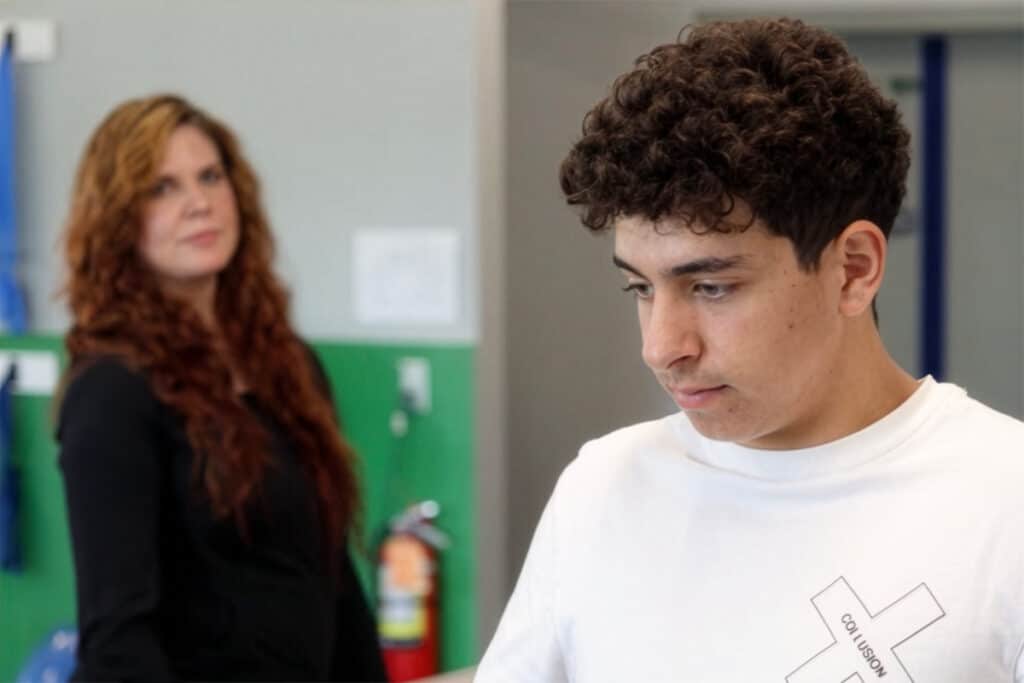
Five Years of Trust Behind One Recovery
Cayden’s current injury may be recent. His relationship with the Brighton clinic isn’t. He’s been coming to Ivy for about five years. That history gives this recovery another dimension. Cayden is surrounded by people who’ve watched him change over time.
Kristen stands out in particular. “She’s seen me grow over the last five years, both as a person and through injuries, recovery, and building strength,” Cayden says.
That familiarity has helped build trust. Cayden knows he can ask questions. He knows he can speak up when something doesn’t feel right. And he knows his care team understands what getting back means to him.
“I love it here,” he says. “The people here are so nice.” Simple sentence. Pretty important point. The exercises and measurements matter. So do the people beside you.
Getting Stronger for the Game Ahead
Getting his knee straight is one step. Getting ready for center midfield is another.
The position demands running, stopping, changing direction, reacting, controlling the ball, and somehow keeping tabs on 21 other players, 11 of whom have absolutely no interest in making your job easier.
As recovery progresses, rehabilitation can become more specific to those demands. Strength, control, balance, conditioning, and sport-specific movement can all become part of preparing an athlete to return. That progression is also central to Ivy’s approach to sports injury recovery for athletes. The destination matters because it helps shape the work that comes before it.
For Cayden, the destination is clear: back to soccer. But the route there still happens one stage at a time.
Your Comeback Deserves the Right Plan
An injury can interrupt a season. It doesn’t get to write the rest of the story.
Whether you’re trying to get back to midfield, your running route, the gym, or another activity you love, the right rehabilitation plan should be built around where you are and where you want to go.
Find an Ivy Rehab location near you and learn how physical therapy can support your return to the activities that matter to you.
References
- Lavoie-Gagne O, et al. “Return-to-Play Times and Player Performance After Medial Collateral Ligament Injury in Elite-Level European Soccer Players.” Orthopaedic Journal of Sports Medicine (2021). https://pubmed.ncbi.nlm.nih.gov/34604429/
- Kew ME, Cavanaugh JT, Elnemer WG, Marx RG. “Return to Play After Posterior Cruciate Ligament Injuries.” Current Reviews in Musculoskeletal Medicine (2022). https://pubmed.ncbi.nlm.nih.gov/36447081/

Before you go
Find the right therapy today.
Discover how Ivy Rehab can help you get back to doing what you love.