For one night a year, we ask kids to dress up, walk up to strangers, and say the same magic words for candy.
Some children say “trick or treat” out loud. Others communicate the same message in different ways. Communication differences are common. The National Institute on Deafness and Other Communication Disorders reports that approximately 1 in 14 U.S. children ages 3 to 17 have had a voice, speech, or language disorder within the past 12 months.
The good news? There’s more than one way to say it. Signs, gestures, pictures, speech-generating devices, and other communication supports can all help children participate in Halloween in ways that work for them.
Saying It with Signs
Some children use signs as part of their communication. While trick-or-treating, they might sign “candy,” “please,” “thank you,” or another message that’s meaningful to them.
They may sign directly to the person handing out candy or to a parent or caregiver, who can share the message verbally. Either way, the message gets across.
That response matters. When someone notices and responds to a sign, gesture, word, or another form of communication, it reinforces something important: My message was heard.
And really, that’s the point of communication in the first place.
Picture-Based Communication and PECS
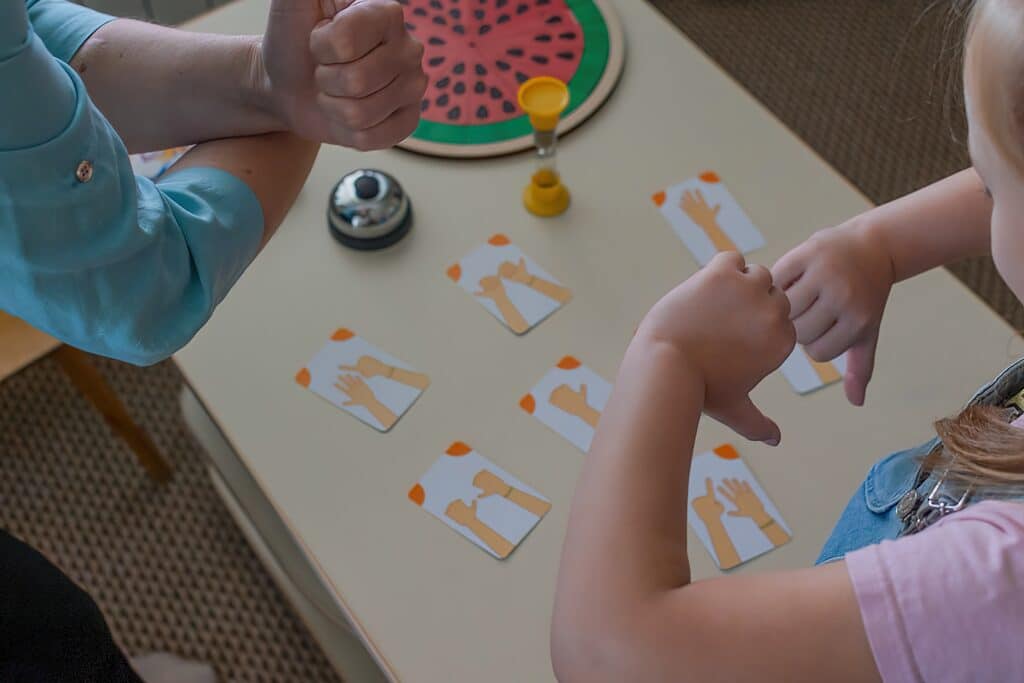
Pictures can provide another way to communicate during Halloween activities. Some children use individual picture cards or communication boards. Others may use a formal system such as the Picture Exchange Communication System (PECS), which involves exchanging pictures or symbols with another person to convey a message.
For Halloween, the pictures can include messages that are especially useful while trick-or-treating. And once you start thinking about it, Halloween has a surprisingly specific vocabulary.
Helpful Halloween messages might include:
- “Trick or treat!”
- “Thank you for the candy!”
- “It can be hard for me to say ‘trick or treat.’ This card says it for me.”
- “I have a peanut allergy. Please let my grown-up check the candy.”
- “Can we take a break or go home?”
- “Loud noises can be hard for me. Please don’t jump out and scare me!”
- “Costumes can feel uncomfortable, but I’m pretending to be a ____!”
- Pictures can also say “no thank you,” “more,” “help,” or “all done.”
If exchanging a picture with someone new feels like a lot at first, practicing with a parent, caregiver, sibling, or therapist before Halloween can help build familiarity. During trick-or-treating, they can show or exchange the picture themselves when they’re comfortable, or a caregiver can help share the message.
The goal isn’t a perfect exchange. It’s successful communication.
Speech-Generating Devices
Speech-generating devices (SGDs) give some children another way to participate in trick-or-treating. These may be dedicated communication devices or apps used on tablets and other technology.
SGDs fall under the broader category of augmentative and alternative communication (AAC). AAC can include many forms of communication, such as gestures, manual signs, picture boards, and speech-generating devices.
Many devices allow families and speech-language pathologists to personalize words, phrases, and icons. For example, buttons can be combined to say “I want candy,” or a single button can be programmed with “trick or treat.”
If one button says it all, one button is enough. The candy won’t know the difference.
Before Halloween, families can work with a speech-language pathologist to add useful seasonal vocabulary. That might include “thank you,” “no thank you,” “I need a break,” “too loud,” “let’s go,” or whatever messages will be most useful that night.
Making Halloween Communication Easier
Knowing how they want to communicate is one thing. Then Halloween adds costumes, doorbells, flashing lights, strangers, and the occasional motion-activated skeleton with no respect for personal space. A little preparation can help children communicate what they want and need throughout the night.
Families can prepare by:
- Practicing useful Halloween words, signs, pictures, or device buttons in advance.
- Making sure communication devices are charged and easily accessible.
- Bringing a low-tech backup, such as a picture card or printed communication board.
- Visiting familiar neighbors first if that helps the child feel more comfortable.
- Letting the child choose how they want to communicate at each house.
- Paying attention to messages such as “no,” “break,” “too loud,” or “all done.”
- Giving the child time to communicate without rushing or requiring a spoken response.
Most importantly, participation doesn’t have to look the same from one house to the next. A child might use their device at one door, gesture at another, let a caregiver help at the next, and decide three houses later that Halloween has officially been Halloween enough.
That still counts as trick-or-treating.

How Speech Therapy Can Help
The communication strategies that help on Halloween can matter long after the costumes are put away. Pediatric speech therapy can support communication in many forms, including spoken language, signs, gestures, pictures, AAC, speech-generating devices, or a combination of approaches.
One common misconception is that AAC will prevent spoken language from developing. Research doesn’t support that idea. The American Speech-Language-Hearing Association reports that AAC can support spoken language development in young children. In one systematic review, 87% of participants showed improvements in vocal utterances, and none of the studies reported decreases in spoken language when speech-generating devices were used.
A speech-language pathologist can help families explore communication options, customize vocabulary, and practice using those tools where communication actually happens: at home, at school, or even on a neighbor’s porch dressed like a dinosaur waiting for a fun-size candy bar.
Communication belongs in all of those places.
There’s More Than One Way to Join In
There’s no single right way to say “trick or treat.”
A child can say it, sign it, point to it, tap a button, hand someone a picture, communicate through a caregiver, or choose not to say it at all. What matters is giving children ways to express themselves and helping the people around them recognize and respond to those messages.
If your family has questions about your child’s communication or wants help finding an approach that works for them, a speech-language pathologist can help you explore the options.
Find pediatric therapy near you and request an appointment.

Before you go
Find the right therapy today.
Discover how Ivy Rehab can help you get back to doing what you love.