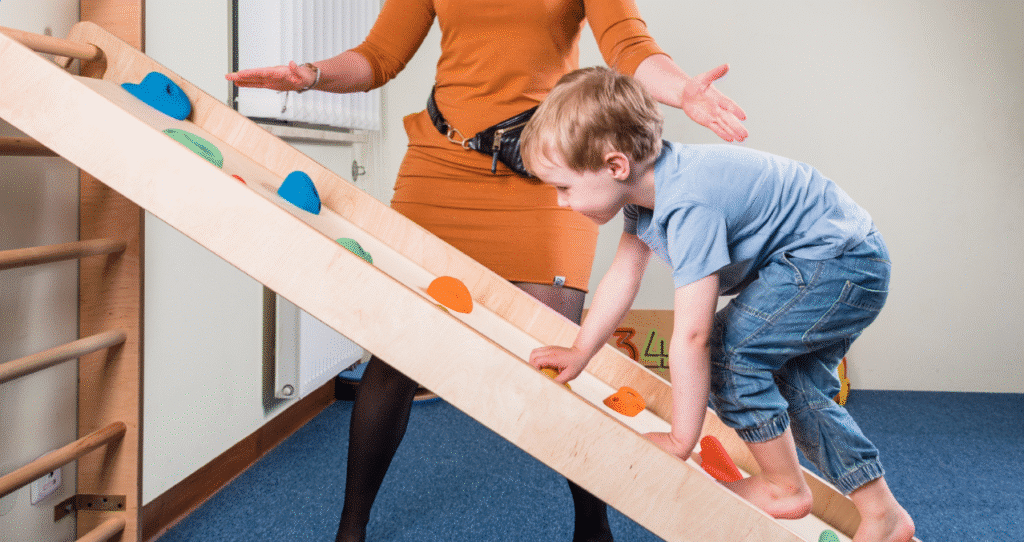
When a child starts therapy, families are often introduced to multiple specialists, physical therapy, occupational therapy, and speech therapy, each focused on a different part of a child’s development.
But the real impact happens when those specialists work together.
At Ivy Rehab for Kids, that collaboration is intentional. It is built into a multidisciplinary pediatric therapy model designed to support the whole child across multiple developmental areas.
For Kori Johnson, clinic director and occupational therapist, this approach starts with one key principle: the family leads the way.
“Multidisciplinary care means that we are all family-centered, and the family is driving the car,” she explains. “They’re the expert on the child.”
Connect with Ivy Rehab for Kids to build a therapy plan that brings every specialist and your family onto the same page.
What Multidisciplinary Pediatric Therapy Really Means
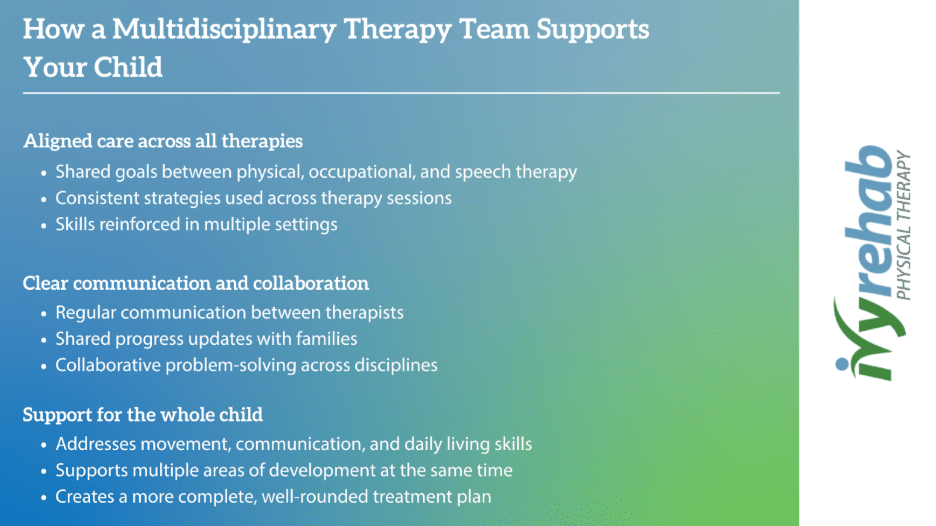
Rather than juggling separate therapies, families have one connected team working toward the same goals. This team operates within a shared multidisciplinary framework, aligning strategies to support the child across:
- Gross motor skills and movement.
- Fine motor skills and daily activities.
- Communication skills and expressive language.
- Sensory processing and emotional regulation.
This kind of collaborative care allows therapists to address the child’s development across multiple domains, creating a more complete and effective treatment plan.
Research continues to show that a multidisciplinary model improves therapy outcomes by addressing the diverse needs of children with developmental delays and developmental disabilities.
Why Collaboration Improves Therapy Outcomes
When therapists collaborate, care becomes more consistent and more effective.
“Collaboration between therapists can improve outcomes by improving the continuity of care,” Kori says.
This continuity matters. Without it, families can receive conflicting recommendations or feel like they are coordinating care on their own.
In a multidisciplinary pediatric clinic, communication among providers ensures that:
- Goals are aligned across all therapy sessions.
- Strategies are reinforced consistently.
- Families receive clear, unified guidance.
“It also models trust and accountability for the family,” Kori adds. That trust creates a stronger, supportive environment where families feel confident in the plan of care.
The Role of Evidence-Based Care and Family Input
In pediatric therapy, decisions are guided by research and clinical expertise. But Kori emphasizes that there is a third piece that is just as important.
“There’s three pillars in evidence-based practice,” she explains. “We always think of the robust research… but a successful multidisciplinary team is also going to balance the patient values and the clinical expertise with honesty and integrity.”
This means that therapy is not just based on data or clinical knowledge. It also reflects the child’s daily life, routines, and priorities.
“The parent is providing the expertise on their child and is helping drive the decision-making of the therapy team,” Kori says.
This kind of collaborative goal setting ensures that therapy remains meaningful and relevant.
What Family-Centered, Multidisciplinary Care Looks Like
In practice, family-centered care means open communication and shared decision-making.
“It looks very honest and open, and sometimes even transparent and uncomfortable,” Kori says. “Everyone’s just working together to do what’s best for the child.”
That transparency shows up through regular communication, including:
- Ongoing updates during therapy sessions.
- Conversations at each plan of care review.
- Clear discussions about progress and next steps.
“If it’s not happening at every session, then at every plan of care update, there should be a conversation,” she explains.
To guide these conversations, Kori often asks families three simple questions:
- What is working for you?
- What am I missing that you need me to do more of?
- Where do you want to see us go from here?
These questions keep the focus on the child’s unique needs and ensure the family remains at the center of care.
The Power of Trust Within the Team
While structured collaboration is important, some of the most meaningful progress happens in everyday interactions between therapists.
“When everyone thinks of multidisciplinary care, we think of the formal round tables,” Kori says. “But something I have found to be the most effective is having this felt safety to go to your team.”
That trust allows therapists to be honest and collaborative in real time.
“I don’t know if what I’m doing is working,” or “Can I get another set of eyes?” are conversations that lead to better outcomes.
“When you’re vulnerable and really trust your team, that’s where you start to see the most improvements in a child’s plan of care,” she explains.
This level of communication strengthens the entire multidisciplinary team approach.
One Plan, Multiple Specialists, Better Results
One of the biggest benefits of a multidisciplinary clinic is having multiple services under one roof.
Instead of families managing separate appointments across different locations, care is coordinated in one place.
This reduces stress for parents and caregivers while improving consistency for the child.
It also allows therapists to:
- Share insights across disciplines.
- Reinforce skills learned in other sessions.
- Adjust the treatment plan in real time.
For example, skills developed in speech therapy, like communication or expressive language, can be reinforced during occupational therapy or physical therapy sessions. This kind of overlap helps children generalize skills more effectively in everyday life.
Supporting the Whole Child
A holistic approach to pediatric therapy focuses on the whole child, not just one area of development. That includes physical, cognitive, emotional, and social growth.
Occupational therapists support independence with everyday activities like dressing, feeding, and play.
Physical therapists focus on strength, coordination, and gross motor skills that help children move and engage with their environment.
Speech therapists support communication, language skills, and social interaction.
Together, these professionals create a well-rounded plan that reflects the child’s full range of needs.
Why This Approach Matters for Families
For many families, navigating therapy can feel overwhelming. A multidisciplinary pediatric therapy model simplifies that process.
Instead of acting as a go-between for different providers, parents receive clear, consistent communication from a single connected team.
This leads to:
- Better understanding of the child’s progress.
- Greater confidence in therapy decisions.
- Higher satisfaction with care.
Most importantly, it creates a stronger partnership between families and therapists.
What Makes This Work Meaningful
For Kori, the most meaningful part of this work comes down to relationships.
“What makes me most excited to go to work in the morning… it’s really the families and it’s the team and the culture,” she says.
Over time, those relationships deepen.
“I’ve known families for five years… it is just like a special, intimate type of relationship that you can’t get anywhere else.”
That connection builds trust, and that trust is what allows children to grow.
A Better Way to Support Your Child
When therapy is collaborative, transparent, and family-driven, it creates a stronger foundation for progress.
Multidisciplinary pediatric therapy brings together the right expertise, the right communication, and the right support system to help children succeed across all areas of development.
Let’s Talk About What Comes Next
If you are exploring pediatric therapy for your child, you do not have to navigate it alone.
At Ivy Rehab for Kids, our multidisciplinary team works together, and with you, to create a plan that reflects your child’s needs and your family’s goals.
Start a conversation with our team today to create a plan that reflects your child’s needs—and your goals as a family.

Before you go
Find the right therapy today.
Discover how Ivy Rehab can help you get back to doing what you love.