Maintaining an active lifestyle is essential to remaining independent throughout life. Regular physical activity provides health benefits, including the strength, flexibility, and balance required to keep up with your daily routine while preventing injury. Studies also show that exercise promotes self-esteem, boosts memory, and reduces mental stress. Especially for older adults, it is important to practice regular exercise to achieve these benefits while also reducing the risk of falls. A sufficient exercise program for older adults will include aerobic activity, flexibility, strength training, and balance.
Why Exercise Is Critical for Fall Prevention and Healthy Aging
For aging adults, exercise is not just about staying active. It is one of the most effective strategies for fall prevention and healthy aging. Falls are a leading cause of injury in older adults, but targeted exercise programs can help improve balance, strengthen key muscle groups, and reduce fall risk.
Activities that build leg and core strength, combined with balance training, help prevent falls by improving stability and coordination. A well-rounded routine supports independence and confidence with everyday tasks such as climbing stairs, carrying groceries, and walking on uneven surfaces.
What Are the Best Exercises for Aging Adults?
1. Walking
As a core exercise for all ages, walking can be especially beneficial for an aging adult. Physical activity guidelines suggest each person should practice either moderate-intensity activity for 30 minutes 5 days weekly or vigorous-intensity activity for 20 minutes 3 days weekly. Walking is an excellent way to achieve 30 minutes of moderate-level aerobic activity to elevate the heart rate.
This promotes functional strength and balance, reduces the risk of cardiorespiratory and musculoskeletal conditions, increases energy and stamina, and reduces the risk of falling. A walking program with friends can help with maintaining the weekly regimen in a fun and social way. Make sure you dress comfortably, wear supportive shoes, keep a water bottle for hydration, and stay in well-lit areas.
Walking in the water is another excellent way to keep up an active lifestyle. For those with arthritic joints who experience discomfort when walking on land, walking in water offers greater comfort and ease. Water aerobics also further promotes strength in the core and upper body due to the water’s natural resistance as you walk through it.
Weight-bearing activities such as walking also help strengthen bones and reduce the risk of osteoporosis. Maintaining bone density is essential as we age, and regular physical activity plays an important role in preserving bone health.
2. Sit-to-Stand
Some simple strength exercises can include sitting to standing. The sit-to-stand exercise builds muscle strength and muscle mass in a functional movement pattern. Practicing repeated sit-to-stands promotes the ability to independently perform other daily tasks, such as getting out of bed and going up the stairs.
Find a comfortable, sturdy chair and take a seat such that your feet are flat on the floor. Bring the shoulders and knees forward. Using your core and leg strength, stand up from the chair. Keep your weight equally distributed through both legs. At the top of this motion, make sure to stand up as tall as you can to promote good posture and engagement of all involved muscles. Sit back down in the chair, and repeat. Attempt these chair exercises without upper-extremity support, such as keeping your arms crossed in front of your chest. However, if strength or balance is limited, you may use the armrests for support.
Perform 10-15 repetitions total, taking rests when needed.
To increase the challenge over time, you can hold light weights or use resistance bands to build strength safely. Resistance bands are especially helpful because they provide adjustable tension while remaining gentle on the joints.
3. Heel Raising
Heel raising is another recommended way to train major muscle groups in a functional movement pattern. Strength training for the calves is important for standing for long periods, going up or down a flight of stairs, and walking safely through the community.
Stand in an upright position with hands on a stable surface such as a countertop or the back of a chair. Raise both heels off the ground as high as you can comfortably, keeping your weight evenly distributed between both legs. Lower back down to the floor. Make sure not to rock the hips or torso backward or forward throughout the motion.
Perform 20-30 repetitions total, taking rests when needed.
4. Stretching
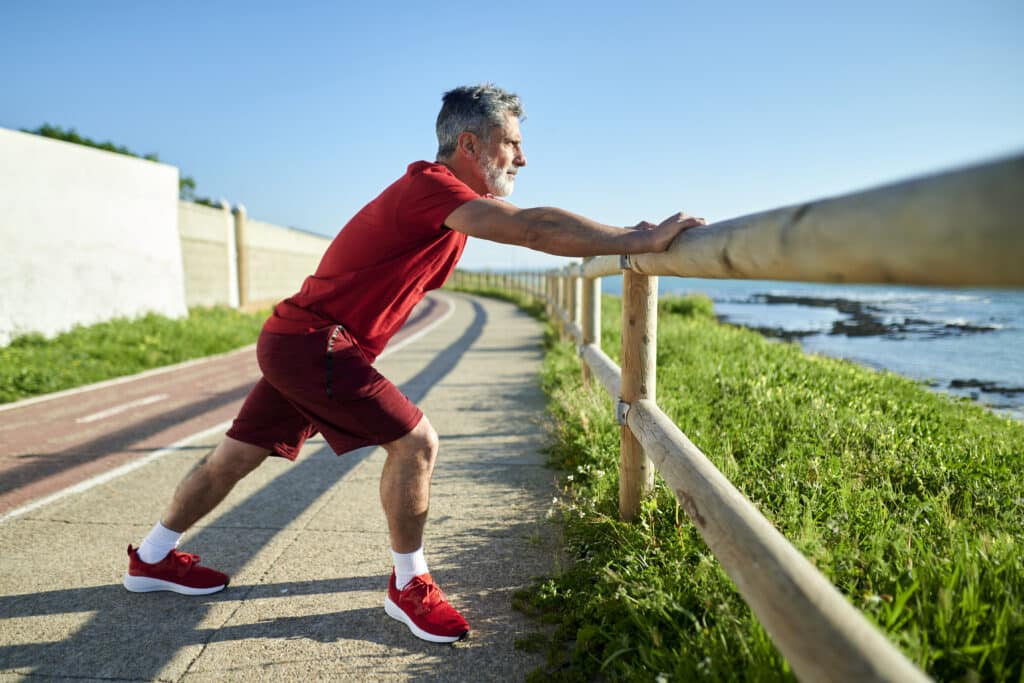
Dynamic stretching exercises are also essential for people of all ages for many reasons, including injury prevention. The greatest gains are achieved by practicing a flexibility exercise routine daily. Stretching is most effective when the muscles are already warm, such as after a walk. An effective stretch to perform every day is for the calf, especially to reduce the risk of falls. Calf flexibility is essential for safely going up and down stairs, walking uphill and downhill, and hiking across an uneven trail.
Stand in an upright position with hands on a stable surface such as a wall or countertop. Place the right foot in front of the left foot in a wide stance. Bend the front leg and bring the hips forward to find a pull at the calf of the back leg. Keep the back leg straight and both heels flat on the floor.
Hold this position for 1 minute. Then switch to perform the same stretch with the opposite leg.
5. Balance
Balance is a critical component of everything we do throughout the day. Showering, dressing, climbing stairs, walking, carrying bags, etc., all require sufficient functional balance. To maintain independence in all daily activities, it is important to perform balance training that challenges stability while remaining safe.
A simple balance exercise can look like this: Stand in an upright position, with your back straight and shoulders relaxed. Place hands on a stable surface such as a countertop or the back of a chair. Bring one foot directly behind the other to stand in a heel-to-toe position, otherwise known as a tandem stance. Hold this position for 30 seconds, then switch to bring the opposite leg forward. Attempt to lift your hands off the counter for a few seconds to further challenge the balance system. If this feels easy, try balancing in a tandem stance with your eyes closed to further challenge your balance.
In addition to tandem stance practice, activities such as Tai chi can help improve balance and body awareness. Tai chi involves slow, controlled movements that challenge coordination and stability, making it an excellent option for older adults who want to improve balance in a gentle way.
What Is the Best Time of Day for Seniors to Exercise?
The best time for seniors to exercise is whatever time they habitually use for daily physical activity. It is best to find a consistent time of day that you can reserve for your exercise routine, whether that is in the morning, afternoon, or evening. Physical activity must become a daily habit to benefit from strength, flexibility, and balance exercises. Studies also show that exercise at any time of day significantly improves sleep quality.
Perhaps your physical exercise program is something you look forward to. In this case, the evening may be the best time so that you have a selected motivator throughout the day. Perhaps completing a workout will elevate your mood. In this case, exercising in the morning can help you start the day strong. It is wise to avoid exercising within the first or last hour of the day to allow the muscles to warm up in the morning or cool down at night before sleeping.
How Physical Therapy Can Help
At Ivy Rehab, we can collaborate with you to develop a program of exercises that addresses flexibility, strength, and balance. We can discuss the specific functional goals you want to accomplish and identify the most effective exercises to achieve them. For both treating various conditions and preventing falls, we can guide you by gradually easing into a safe exercise program that avoids doing too much too soon. Together, we can create a program that feels meaningful and impactful to you. Physical therapy can be highly beneficial in making safe exercise a lifelong part of the day! Click here to find a location near you.

Before you go
Find the right therapy today.
Discover how Ivy Rehab can help you get back to doing what you love.