Visual perceptual skills are important so that we can successfully complete daily tasks. As children get older, they can utilize these skills to participate in play, home, sports, and school activities. Without addressing these skills, your child may feel upset or frustrated, which may impact them from completing an activity effectively.
What is Visual Perception?
Visual perception is a term that refers to how our brain processes information through our eyes to interact with the world around us. Our eyes have a bigger role than just being able to see. They help to take in all the information and:
- Determine sizes
- Recognize different shapes and formations of letters
- Follow patterns
- Observe the spacing between letters and numbers
- Pull important information from a busy background
- “See” part of an object without it being complete
Visual Attention, Visual Memory, Visual Closure
While visual perception helps us make sense of what we see, several related skills work together to support this process:
- Visual attention is the ability to focus on what’s important, like finding a favorite toy in a pile or spotting a friend in a busy playground.
- Visual memory allows a child to remember what they’ve seen before, which helps with recognizing letters, numbers, and shapes while reading or writing.
- Visual closure helps children “fill in the blanks” by identifying an object or word even when part of it is missing or covered.
Together, these skills help children process the visual world and build confidence in learning, play, and daily routines.
Types of Visual Perception
Visual perception includes several important components that support a child’s development and independence:
- Visual discrimination – Telling the difference between shapes, letters, or colors.
- Visual figure-ground – Finding objects in a busy background (like locating a pencil on a crowded desk).
- Visual sequencing – Understanding the correct order of letters, numbers, or steps in a task.
- Visual form constancy – Recognizing that an object or shape stays the same even if it’s in a different size, color, or position.
- Visual spatial relationships – Understanding how objects relate to each other—above, below, next to, or behind.
- Visual motor integration – Coordinating what the eyes see with how the hands move, which supports writing, cutting, and sports.
When these areas work together, children can participate more easily in classroom learning, games, and daily activities.
Visual Perceptual Milestones
As a child grows up, the visual perceptual milestones they should be reaching change and evolve. Below, you will find age-appropriate visual perceptual milestones for each age group.
2 ½ – 3 ½ years
- Match shapes that are similar to each other
- Complete 3-piece puzzles
- Sort different shapes from each other
- Recall a few things from the pictures
- Draw vertically, horizontally, and in a circle
3 ½ – 4 ½ years
- Complete 4-5 piece puzzles
- Recognize the difference in shape sizes
- Recognize the entirety of an image with only half presented
- Identify what objects are similar or not similar to each other
- Draw a cross
- Trace lines
4 ½ – 5 ½ years
- Identify differences in shape sizes (largest to smallest)
- Sort objects by shape, size, color
- Match letters
- Draw a square
- Cut a circle and square out of paper
- Connect dots with a straight line
5 ½ – 6 years
- Complete interlocking puzzles (10-12 pieces)
- Understand the difference between upper and lower case letters
- Color between lines
Difficulties in Visual Perceptual Skills
If a child experiences difficulty with visual perceptual skills, there are a number of tasks and milestones that they may not be able to complete. Below is a list of tasks or areas where a child may experience issues:
- Understanding the difference between letters, numbers, words
- Cutting on the right line during school activities
- Understanding that letters, numbers, and shapes are similar even when rotated
- Recognizing the difference between letters, numbers, and symbols in different fonts
- Knowing the difference between upper and lower case letters
- Trouble copying shapes from pictures
- Finding objects in spaces (toy boxes, bins)
- Copying words from the board on a page
- Difficulty remembering to follow an order of steps
- Creating a line on a page
- Drawing shapes
- Writing name and words on a line
- Understanding directional terms (up, down, across, behind, between, forward)
- Following the formation of letters (starting at the top and then the bottom)
- Reading from left to right
Visual Perception Tests
Occupational therapists use a variety of assessments to understand how a child processes visual information. These tests might include puzzles, shape matching, or drawing activities that measure how well a child interprets what they see.
Tools such as the Developmental Test of Visual Perception (DTVP) or the Beery-Buktenica Developmental Test of Visual-Motor Integration (Beery VMI) help therapists identify specific challenges and guide personalized treatment plans. The results allow therapists and parents to work together to create strategies that strengthen a child’s skills both in therapy sessions and at home.
Activities to Improve Visual Perceptual Skills
Simple, play-based activities can help boost visual perceptual development:
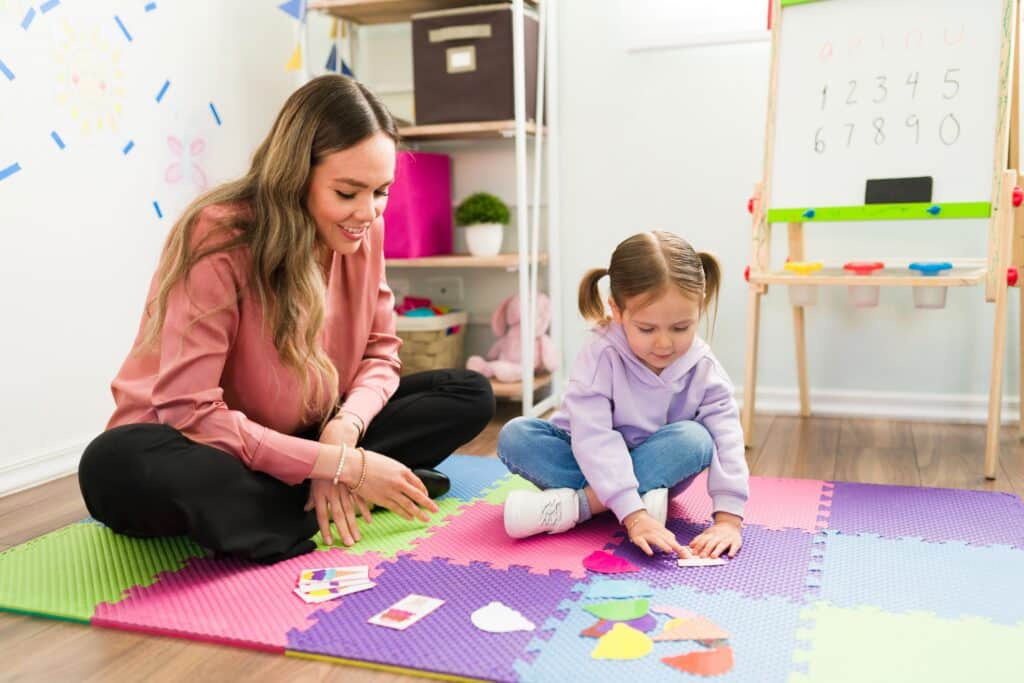
- Completing puzzles or matching games
- Playing “I Spy” or scavenger hunts to practice visual attention
- Drawing and coloring inside the lines
- Tracing letters, shapes, and mazes to support hand-eye coordination
- Building with blocks or LEGOs to improve spatial awareness
- Cutting out shapes or connecting dots to develop fine motor and visual-motor integration
Incorporating these activities into your child’s daily routine not only strengthens visual skills but also makes learning fun and engaging.
Help Your Child Master Everyday Skills with Ivy Rehab
If you see that your child is having trouble with any of the visual perceptual skills listed above, contact one of our pediatric occupational therapists to help address your concerns. At Ivy Rehab, our therapists use creative, evidence-based approaches to help children thrive—one playful step at a time. Visit our website for location information or to schedule pediatric OT services online.

Before you go
Find the right therapy today.
Discover how Ivy Rehab can help you get back to doing what you love.