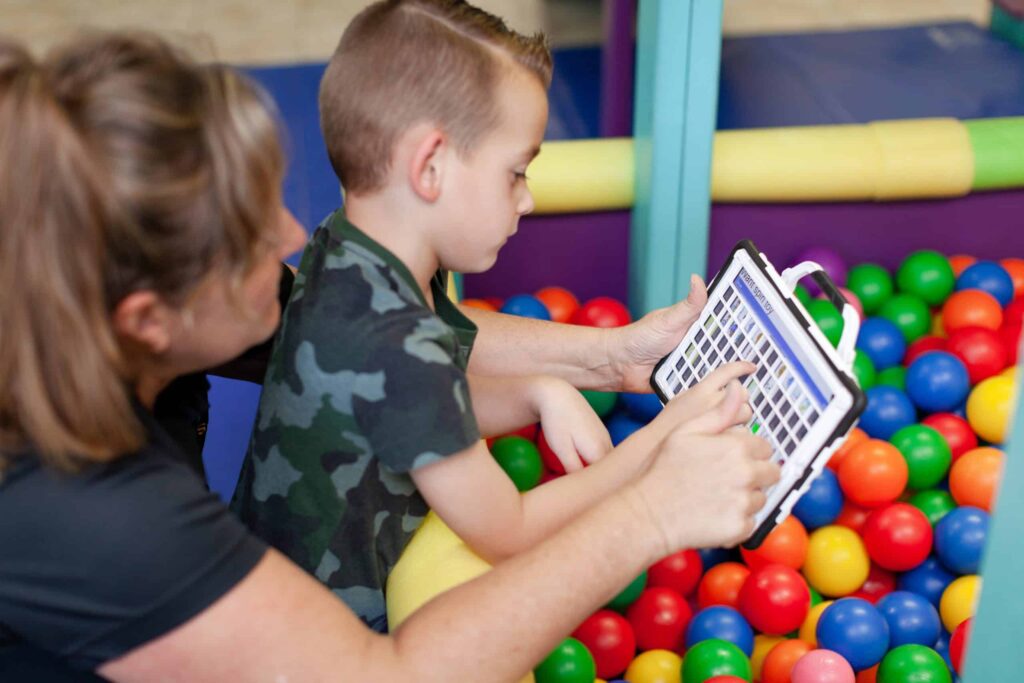
What is language? How many words should my child be saying? What is a communication disorder? What is early intervention? How do I know if my child needs intervention?
These are just some common questions parents raise when they become concerned about their child’s communication skills. Understanding when and how children are expected to communicate helps parents make important early intervention decisions to support and encourage their child’s language development.
Language is the code in which humans communicate and share meaning. We use language to express our thoughts, wants, and needs. When language delays are suspected, a speech-language pathologist will examine different aspects of language. Understanding the language development milestones helps determine if a child is experiencing delays in language and speech development. If they are experiencing delays, it could be a sign of a developmental disability.
How to Use These Speech and Language Milestones
These speech and language milestones are meant to help you understand what to expect as your child grows and to know when to seek help. They are not a screening or diagnostic tool, but they can help guide conversations with your child’s doctor, an audiologist, or a speech-language pathologist.
Receptive Language and Expressive Language
The two main areas of language are receptive language and expressive language.
Receptive Language
Receptive language is the ability of a person to understand the code in which other people are communicating with them. We ask:
- What do they understand?
- Can your child follow directions?
- Can your child point to pictured objects when asked?
- Can your child respond appropriately to questions and gestures?
Receptive language includes comprehending what is said and what is read or written. A speech-language pathologist will evaluate what a child understands and how they respond to others.
Expressive Language
Expressive language is the ability to use the correct code to communicate with others.
To determine expressive language ability, we ask:
- Can they string sounds together to make words and string words together to make sentences to share their thoughts and feelings?
- Can your child express themselves, their wants, and their needs through verbal and nonverbal means of expressive language?
- Can your child ask questions?
- Can your child use gestures?
- Can your child use language for a variety of functions or reasons?
A speech-language pathologist will assess the child’s language abilities and how they use language to relate to others.
What Are the Major Milestones of Language Development?
Developmental milestones in a young child range from birth to about 5 years old.
Birth to 1 year
Reception Language
- Smiles at familiar voices & faces.
- Pays attention to toys.
- Turns when their name is called.
- Starts to understand common words in their environment, such as “mommy” and “daddy.”
- Understands commands such as “no” and “give me.”
Expressive Language
- Coos.
- Cries in different ways for different reasons.
- Giggles and laughs.
- Babbles using early developing sounds such as p, b, and m.
- Uses gestures, like waving hi.
- Attempts to imitate adult speech.
- Produces 1-2 words.
By 6 months of age, most babies recognize the basic sounds of their native language and begin sorting out the speech sounds that make up words.
1 to 2 years
Receptive Language
- Follow one-step directions.
- Responds to yes/no questions.
- Responds to “wh” questions like “What?”
- Looks at pictures in books.
- Points at pictures.
- Sings songs.
Expressive Language
- Imitates and uses new words.
- Names objects in pictures.
- Starts to ask questions such as “What?”
- Combines two words together.
- Such as “Daddy go” or “more cookie.”
At this stage, many children understand simple phrases, enjoy being read to, follow one-step commands with a gesture, and say two to three words to label people or objects. Their vocabulary often grows quickly during these months of life.
2 to 3 years
Receptive Language
- Follows two-step directions.
- Continues to understand new words.
- Responds to more complex questions such as “What are you doing?” and “Where?”
- Understands prepositions (in, on, under) and action words.
Expressive Language
- Uses new words often.
- Combines 2-3 words.
- Uses 2-3 words to ask for things.
- Asks questions such as “Where?” and “Why?”
- Uses words with later-developing sounds such as k, g, t, d, and n.
3 to 4 years
Receptive Language
- Develops an understanding of more abstract vocabulary, such as color and shape words.
- Understands feeling words.
- Plays next to peers.
- Takes turns.
Expressive Language
- Begins to have conversations with self and others.
- Talks about experiences.
- Combines 4 to 5 words to make sentences.
- Asks questions such as “When?” and “How?”
- Uses parts of speech such as plural ending –s and present progressive ending –ing.
- Uses a variety of pronouns like “I, you, me, and mine.”
4 to 5 years
Receptive Language
- Follows multi-step directions (3-4 steps).
- Understands language specific to the classroom, such as “Cut out the circle and glue it on the paper.”
- Takes turns in conversations.
- Understands order (i.e., first and last).
Expressive Language
- Names letters, numbers, and shapes.
- Repeats for clarification.
- Uses later-developing sounds l, f, s, z, j, ch, and sh.
- Tells stories.
- Talks about their day.
- Able to have back-and-forth conversations.
How Do Speech and Language Develop?
Speech and language develop from birth and are nurtured in rich-language environments. Research has shown that the critical periods for learning speech and language are within the first three years of life.
Children learn speech and language in stages. Children exposed to constant communication from others, social groups, and various sights and sounds, such as reading books, reciting nursery rhymes, and singing songs, are provided ample opportunities to develop speech and language within developmental expectations.
What Happens When Language Development Is Delayed?
Language developmental delay can happen for numerous reasons. A child may not have opportunities to learn in a language-rich environment, or they may miss opportunities to learn speech and language for less obvious reasons, even though their parents provide thoughtfully designed learning areas.
Language delays are symptoms of other delays, disorders, or medical conditions. For example, a child might present with hearing loss that prevents them from hearing all sounds or just certain sounds, or a child might be unable to make eye contact and struggle to imitate actions and words. A child may be exhibiting difficulty forming sounds with their mouth because they can’t plan the motor movements necessary for speech. Maybe a child presents with a cleft palate, making it difficult structurally to produce specific consonant and vowel sounds. These are just some of the reasons why language delays occur.
Effects of Developmental Delay
When language development is delayed, children may struggle in various ways, such as:
- Attending to and imitating others’ facial expressions.
- Imitating gestures.
- Imitating sounds and words.
- A baby may not laugh and giggle at her mother’s funny face.
- A toddler may not gesture for or attempt to name things they need, like a drink or food.
- A young preschooler may struggle to follow one-step directions or may not be understood by others because they lack enough sounds in their sound inventory.
- An older preschooler may struggle to play cooperatively with others or talk about their day.
Children develop at their own rate. However, early intervention is key to minimizing or preventing further delays when a child presents one.
At What Age Is Speech Considered Delayed?
There is significant variability in speech and language development in children, especially beyond 12 months. Some pediatric specialists may say there is a range of typical developmental milestones at each age and stage. However, speech is considered delayed when a child does not meet that milestone for their age.
For example, a child aged 12 to 15 months who is not responding to their name, gestures, or babbling has a speech and language delay. At this age, a parent should observe their child:
- Looking at faces.
- Turning to their name.
- Following simple directions.
- Hearing constant babbling. Babbling should include sounds such as p-, b-, and m-. It should sound like “bababa” or “papapa.”
- Using their bodies and voices to relate to their environment.
This is one example of when a child may not be reaching a developmental milestone. There are different ways delays in language development milestones can manifest.
When to Seek Professional Support
If your child is not meeting expected communication milestones, it may be time to consult a professional. Early support can make a significant difference.
A child’s doctor may recommend further evaluation or refer you to an audiologist to assess hearing, since hearing plays a critical role in speech and language development. Speech-language pathologists may also use a screening or diagnostic tool to better understand your child’s needs.
How to Support Language Development at Home
There are simple ways to help children develop strong communication skills:
- Talk with your child throughout daily routines.
- Read books together and discuss pictures.
- Encourage imitation of sounds, words, and actions.
- Ask questions and allow time for responses.
- Use repetition to reinforce new words.
These activities help stimulate language development and support communication growth over time.
Ivy Rehab for Kids Can Help
If you are concerned that your child’s speech and language skills are delayed, it’s a good time to speak with your pediatrician and make an appointment with one of our licensed speech-language pathologists for a speech therapy evaluation.
At Ivy Rehab for Kids, our speech-language pathologists are trained and licensed to treat a variety of communication delays and disorders, including:
- Feeding delays
- Picky eating
- Language delays
- Articulation
- Voice
- Fluency
We can help you gain a clearer understanding of your child’s communication skills and determine whether your child may benefit from speech and language therapy. Visit our website to request an appointment online or find a location near you.

Before you go
Find the right therapy today.
Discover how Ivy Rehab can help you get back to doing what you love.