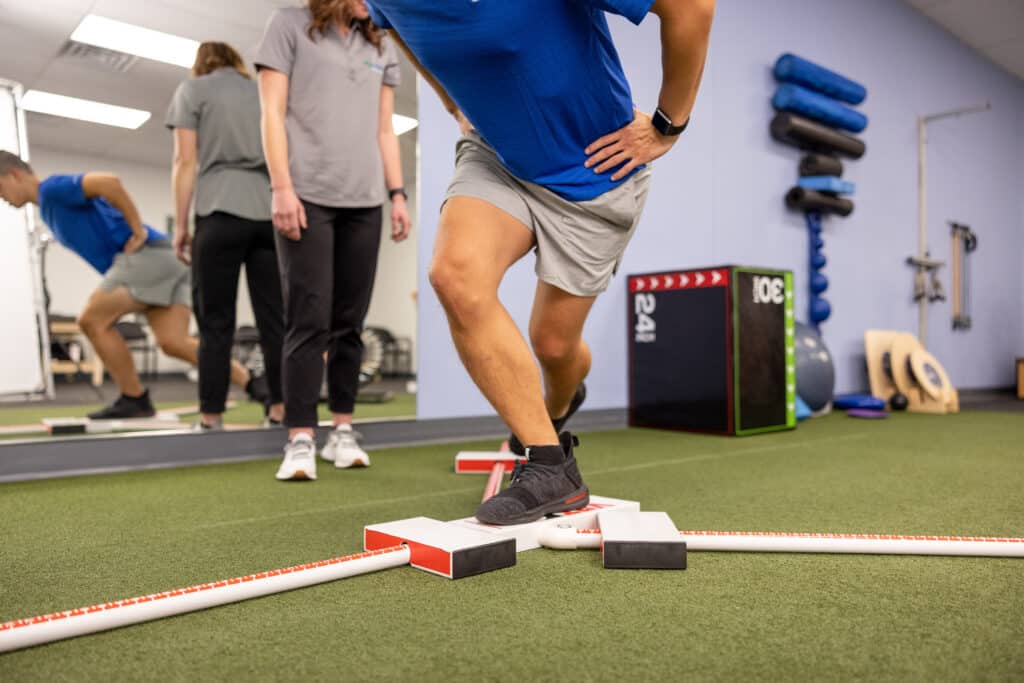
Mobility and stability are both essential for healthy movement, but they play very different roles behind the scenes. Mobility determines how freely a joint can move, while stability determines how well your body can control that movement once it gets there. Think of it this way: mobility opens the door, and stability makes sure you don’t trip walking through it.
Physical therapy can help identify whether your body needs more mobility, more stability, or (most often) a smarter balance of both.
Mobility vs. Stability
Understanding mobility vs. stability starts with knowing how each contributes to movement, and why neither works well alone. Mobility is the ability of a joint to move through its full range of motion, while stability is the ability to control that motion and maintain proper alignment during movement. In other words, it’s not just about how far you can move, but how well you can own that movement. Mobility without stability leaves movement unpredictable, and stability without mobility makes it restricted.
Flexibility vs. Mobility vs. Stability
Flexibility, mobility, and stability are often used interchangeably, but they’re not the same thing, and your body definitely knows the difference.
Flexibility refers to the length of muscles and how far they can stretch, mobility refers to how well a joint can actively move through its range, and stability refers to how well the body controls that motion during activity. You can be flexible without being mobile, and mobile without being stable, but the sweet spot is having all three working together.
Why You Need Both
Good movement isn’t just about moving more; it’s about moving optimally. That requires enough mobility to access the range, and enough stability to use it safely and efficiently.
This balance isn’t just theoretical—it shows up in real outcomes. In fact, research shows that after eight weeks of mobility and stability training performed three times per week, individuals demonstrated significant improvements in static balance, including single-leg and double-leg control.
Let’s break down how each one plays a role in the way your body moves.
Mobility for Efficient Movement
Limited mobility can quietly make everyday movements harder than they need to be. When joints are stiff, the body tends to compensate in ways that feel helpful in the moment but often lead to soft-tissue strain and fascial restrictions elsewhere, disrupting movement patterns over time.
Stability for Control and Support
Without enough stability, movement can feel shaky, unpredictable, or just off. That lack of control can lead to poor balance, extra stress on joints, and a higher risk of injury. It’s important to reduce the risk of injury over time by training stability alongside mobility.
Joint Stability vs. Mobility
Across the body, joints follow a predictable pattern in the body: some joints are meant to move across different planes of motion, while others are meant to provide control.
Understanding which joints fall into each category helps you train your body more effectively and avoid unnecessary strain.
Joints That Need More Mobility
Some joints are designed to move more freely and cover a wide range, such as:
- Shoulders
- Hips
- Thoracic spine
These areas thrive on mobility to keep movement smooth, efficient, and adaptable. If these joints get stiff, other areas often try to pick up the slack.
Joints That Need More Stability
Other joints are more about support than showmanship:
- Knees
- Low back
- Feet and ankles
These areas rely on stability to maintain alignment, absorb force, and keep everything working together. When stability is lacking, these joints tend to take on more stress than they’re built for.

Signs You May Need More Mobility
Mobility limitations often show up as stiffness, restriction, or that subtle feeling of “why does this feel harder than it should?” Common signs include:
- Difficulty reaching certain positions.
- Feeling tight during movement.
- Limited range of motion.
These issues can make physical activity and daily tasks feel more challenging and less enjoyable than they need to be.
Signs You May Need More Stability
Stability issues tend to show up as a lack of control, even if strength is present. You may notice signs like:
- Shaky or unsteady movement.
- Poor balance.
- Repeated strain or discomfort.
These patterns suggest your body isn’t fully controlling movement, even if it looks like you’re doing everything right.
How to Train Mobility and Stability Together
The best approach to the balance between mobility and stability isn’t choosing one, it’s training both in a way that actually transfers to real life movement.
Here’s how mobility and stability training break down in practice:
Mobility Exercises
Mobility work focuses on improving the range of motion you can actually use:
- Stretching exercises.
- Joint mobility drills.
- Controlled range-of-motion movements.
These help your body move more freely and with more confidence.
Stability Exercises
Stability work focuses on control, coordination, and support:
- Balance exercises.
- Core strengthening.
- Single-leg control work.
These help your body manage movement, not just produce it.
Reclaim Your Strength and Mobility
Experience tailored physical therapy programs designed to alleviate pain and restore function.

How Physical Therapy Helps
Physical therapy helps uncover whether mobility and stability issues are holding you back, and more importantly, how to address them effectively.
Here’s what that process looks like in a physical therapy setting:
Movement Assessment
A physical therapist takes a close look at how your body actually moves, not just how it looks on the surface. This includes posture, joint motion, strength, and balance, with the goal of identifying what’s limiting movement or creating unnecessary strain.
Individualized Treatment Plan
No two bodies move the same, so treatment shouldn’t either.
A well-rounded plan typically includes:
- Mobility work to improve the range of motion.
- Strengthening for stability.
- Movement retraining for better control.
This approach supports meaningful, lasting improvements rather than short-term fixes, often drawing on principles of orthopedic therapy.

Why Choose Ivy Rehab for Mobility and Stability Training
Ivy Rehab provides personalized, non-surgical care focused on improving how you move and how you feel while you move.
It starts with understanding your body. Your physical therapist looks at how your joints move, how your muscles work together, and where things may be breaking down. From there, we build a plan that balances mobility and stability to fit your goals and daily life.
Our physical therapists guide patients in building both mobility and stability over time, not just in the clinic, but in the movements that matter most to you. The result is a stronger, more reliable foundation that supports everyday movement, reduces strain, and helps you stay active long term.
Mobility vs. Stability: The Bottom Line
Mobility vs. stability isn’t a competition; it’s a partnership. When both are working together, movement feels smoother, stronger, and more efficient. That’s when your body starts doing what it was built to do: move well, move often, and move with confidence.
Ready to move better with the right balance of mobility and stability? Find a location near you.
References
- Motor Functions and Mobility Considerations for Function-Based Rehabilitation. Physiopedia. Accessed 2026. https://www.physio-pedia.com/Motor_Functions_and_Mobility_Considerations_for_Function_Based_Rehabilitation
- The Impact of Mobility and Stability Training on Balance Performance in Elite Surfers. ResearchGate. Accessed March 2026. https://www.researchgate.net/publication/390746916_The_Impact_of_Mobility_and_Stability_Training_on_Balance_Performance_in_Elite_Surfers

Before you go
Find the right therapy today.
Discover how Ivy Rehab can help you get back to doing what you love.