

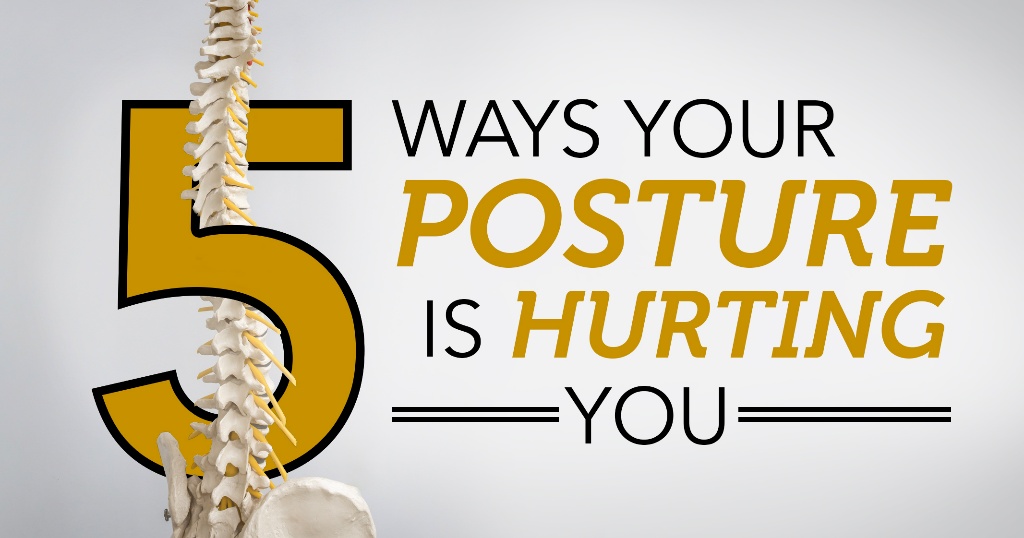
Poor postural habits are something that most of us, as humans, are guilty of from time to time. But do we ever really stop and consider the consequences our bodies suffer as a result? With the addition of smartphones and tablets to our lives, most of us spend more time in a hunched position than we realize. These sustained postures can have detrimental effects on our spine and surrounding joints and soft tissues.
What Is Bad Posture?
When you look at a picture of the spine from the side, you will notice that it is not straight up and down. In fact, it has several curves that form an “S” shape, which is important for absorbing the stress placed on our bodies.
When we lose those normal curves from prolonged poor posture, pain can result from abnormal stresses on our muscles, ligaments, and spinal discs.
The lower back (lumbar spine) and the neck (cervical spine) have a normal backward curve called lordosis, whereas the upper back has a forward curve called kyphosis.
When these natural curves are exaggerated or flattened due to bad posture, increased pressure is placed on the lumbar spine. Over time, this can contribute to chronic back pain, muscle fatigue, and stiffness.
Many people who sit for long periods at a desk experience this type of postural back pain without realizing that posture is the root cause.
What Is Forward Head Posture?
A common postural deviation seen in physical therapy is forward head posture.
When viewing the body from the side, normal posture is when you can draw a straight line from your earlobe to the tip of your shoulder, to the bony prominence on the outside of your hip, to the outside of your knee, and to the back of the arch of your foot.
A forward head posture is noted when the earlobe sits in front of the tip of the shoulder, often with straightening of the neck’s curvature and an increased curve in the upper back.
The Role of Pelvic Tilt in Postural Dysfunction
Another common issue is anterior pelvic tilt, in which the pelvis rotates forward, exaggerating the lower back curve. This tilt can tighten the hip flexors and lower back muscles while weakening the abdominal and glute muscles. Over time, this imbalance can contribute to back pain and reduced hip range of motion.
Correcting pelvic alignment is an important part of restoring good posture throughout the entire body.
Over the long term, this posture causes the following problems that are common reasons for patients to seek physical therapy:
1. Headaches
When you lose the normal backward curve of your neck, and your cervical spine straightens or even begins to curve forward, the face will ultimately be directed toward the floor. To see where you are going or look ahead, your spine compensates by extending the head at the upper neck.
This will cause shortening of the muscle under the back of your head, as well as shortening of your SCM on the front of your neck. When stressed, these muscles can contribute to headaches.
Additionally, the nerves and joints in the upper neck can be compressed, causing neck pain that can radiate into the head.
2. Neck Pain
Loss of the cervical curve will place increased tension on the ligaments along the back of the neck and the back wall of your cervical spinal discs. This increased tension can lead to the formation of bone spurs where these ligaments attach, as well as an increased risk of tears in your discs, which can lead to herniated discs.
Bone spurs and herniated discs can affect the nerves that run from your spinal cord in your neck to your arms, causing pain, numbness, tingling, and weakness.
3. Shoulder Impingement
When the forward curve of your upper back increases, your shoulder blades sit more forward and higher on your back.
When raising your arms overhead, your shoulder blades must rotate in a particular way to allow full shoulder motion. When the position of your shoulder blade on your trunk changes, this rotation can decrease, and you are now at an increased risk of pinching of tendons in your shoulder when you raise your arm overhead.
This is called shoulder impingement, and it can lead to pain and tendon breakdown, increasing your risk of tendon tears.
4. Jaw Pain
Pain in and around the temporomandibular joint (TMJ) can be common with forward head posture due to abnormal stress points on the mandible (lower jaw bone) and the soft tissues around your TMJ.
If you compensate for the loss of your cervical curve with head extension, the muscles that open your mouth are placed on stretch, and your mouth will rest in an open position. In order to keep your mouth closed at rest, the muscles that close your mouth will work extra hard, which can cause pain in the cheeks, head, and jaw.
Additionally, increased stress on the soft tissues around the TMJ can cause pain and clicking/popping.
5. Respiratory Dysfunction
To take a nice, deep breath, the lungs need room to expand within a mobile, flexible rib cage.
When your posture is hunched forward, your ribs have less ability to move and expand, leading to shallower breathing and excessive use of your accessory breathing muscles in your neck. This type of breathing pattern can further contribute to neck pain and can have serious effects on people with underlying respiratory disorders.
Simple Ways to Improve Your Posture Today
Small changes can make a meaningful difference:
- Adjust your workstation so your screen is at eye level
- Avoid sitting for long periods without standing and stretching
- Keep both feet flat on the floor while seated
- Gently draw your shoulders back and down
- Engage your core muscles while standing
These strategies promote proper posture and can help reduce back pain and neck strain throughout the day.
We’re Here to Help
All of these problems may sound scary, but the good news is that physical therapy can help reverse these dysfunctions. Physical therapists are trained in manual therapy techniques to stretch and mobilize your tight soft tissue and joints, and will instruct you in exercises to strengthen your weak muscles to improve your overall posture and movement. To request an appointment with one of our highly-trained physical therapists, click here!

Before you go
Find the right therapy today.
Discover how Ivy Rehab can help you get back to doing what you love.