


Most running injuries don’t start with one dramatic misstep. They tend to build quietly over time.
As you log mile after mile, small inefficiencies in your stride can place repeated stress on the same joints and tissues. One slightly overloaded knee. One hardworking Achilles. One hip doing overtime without backup.
Those tiny movement flaws add up. When your body absorbs force thousands of times in a single run, even minor imbalances can turn into persistent pain.
That’s where gait analysis for runners can make all the difference. It shows you how your body truly moves, not just how it feels early in a run when your legs are still fresh.
The physical therapists at Ivy Rehab Therapy combine gait data with hands-on clinical expertise to reduce injury risk, improve efficiency, and help you move smarter, safer, and stronger through comprehensive sports physical therapy care. Because the goal isn’t just finishing the run. It’s finishing strong and doing it again tomorrow.

What Is Gait Analysis for Runners?
Gait analysis for runners is a detailed evaluation of how your body moves during running. It examines how your body moves with each stride, including alignment, muscle control, and force absorption. It examines the relationship between your stride, alignment, muscle control, and force absorption.
An Ivy Rehab physical therapist will evaluate:
- Stride length and cadence.
- Foot strike pattern.
- Joint alignment at the ankle, knee, hip, and pelvis.
- Symmetry between sides.
The goal isn’t to label your stride as “good” or “bad.” Running isn’t a morality test. It’s to help identify movement patterns that may increase stress or limit efficiency. That insight becomes the foundation for smarter injury prevention.
You may have heard terms like neutral, overpronation, or underpronation. Pronation simply describes how the foot rolls inward to absorb force. It’s normal. It’s necessary. But pronation alone doesn’t tell the full story.
A physical therapist assesses how the foot, ankle, knee, hip, and trunk work together, because true durability depends on the entire kinetic chain, not just what your arch does on contact. This whole-body approach is central to effective physical therapy services.
Why Gait Mechanics Matter for Running Injury Prevention
Running is beautifully repetitive. Even a short three-mile run can involve more than 4,000 foot strikes per leg. That’s thousands of reps with your entire body weight landing on one foot at a time.
If your gait mechanics amplify stress at the knee, overload the Achilles tendon, or strain the hip, those forces compound quickly. Over time, tissue tolerance gets exceeded, leading to injuries.
Research consistently shows that running-related injuries are common. Large epidemiological studies report that approximately 37% to 56% of recreational runners experience an injury each year.
When mechanics improve, running performance often improves, too. You’re no longer fighting your body with every step. You’re working with it. That’s what it means to optimize your running.

Common Running Injuries Linked to Faulty Gait Mechanics
Many overuse injuries stem from movement patterns rather than mileage alone. Training volume matters. But how you move matters just as much.
Common injuries associated with inefficient gait mechanics include:
- Shin splints (medial tibial stress syndrome).
- Runner’s knee, also called patellofemoral pain syndrome (PFPS).
- Achilles tendinopathy.
- Iliotibial (IT) band syndrome.
- Stress reactions and stress fractures.
- Hip or low back pain.
These injuries often reflect repetitive loading issues rather than a single traumatic event. Addressing the movement pattern doesn’t just calm symptoms; it also helps improve overall function. It reduces recurrence and supports long-term running injury prevention.
Key Gait Mechanics Physical Therapists Evaluate
A treadmill and slow-motion video are helpful tools, but numbers alone don’t tell the full story. Physical therapists analyze movement quality, control, coordination, and how your body responds under load.
Foot Strike & Loading Patterns
Your therapist evaluates how and where your foot contacts the ground. Heel strike, midfoot strike, and forefoot strike patterns each have different loading characteristics.
The key question isn’t which pattern is “best.” It’s whether your loading strategy matches your strength, mobility, and training demands. The right pattern for your unique running style is the one your body can support consistently and safely.
Cadence & Stride Length
Overstriding can increase braking forces and stress at the knee and hip. A cadence that’s too low often correlates with longer, heavier steps. Longer steps also increase ground contact time, which amplifies the loading forces your joints absorb with every stride.
Small adjustments in step rate, often just 5 to 7 percent, have been shown to reduce joint loading in some runners. Subtle shifts can make meaningful differences.
Hip & Pelvic Control
The hip is a powerhouse in running. If it lacks strength or control, the pelvis may drop excessively during stance. The hamstrings and quads also play a crucial role in absorbing ground forces and maintaining a stable, efficient stride.
That instability can cascade downward, affecting knee alignment and foot mechanics. Strong hip control supports efficient gait mechanics and reduces compensations that drain energy and increase stress.
Knee Tracking & Alignment
Physical therapists assess how the knee tracks during loading. Excessive inward movement, sometimes called dynamic valgus, can increase stress on the patellofemoral joint.
Improving strength and neuromuscular control often helps optimize alignment without forcing unnatural movement. Addressing running mechanics this way supports natural, efficient motion rather than artificial correction. The goal isn’t robotic running. It’s resilient running.
Trunk & Arm Mechanics
Your upper body isn’t just along for the ride. Excessive trunk rotation or inefficient arm swing can disrupt rhythm and efficiency.
Balanced upper-body mechanics help maintain forward momentum, conserve energy, and support smoother strides from head to toe, often reinforced through targeted gait training physical therapy.
How PT-Led Gait Analysis Prevents Running Injuries
Generic advice can help. Individualized care changes outcomes.
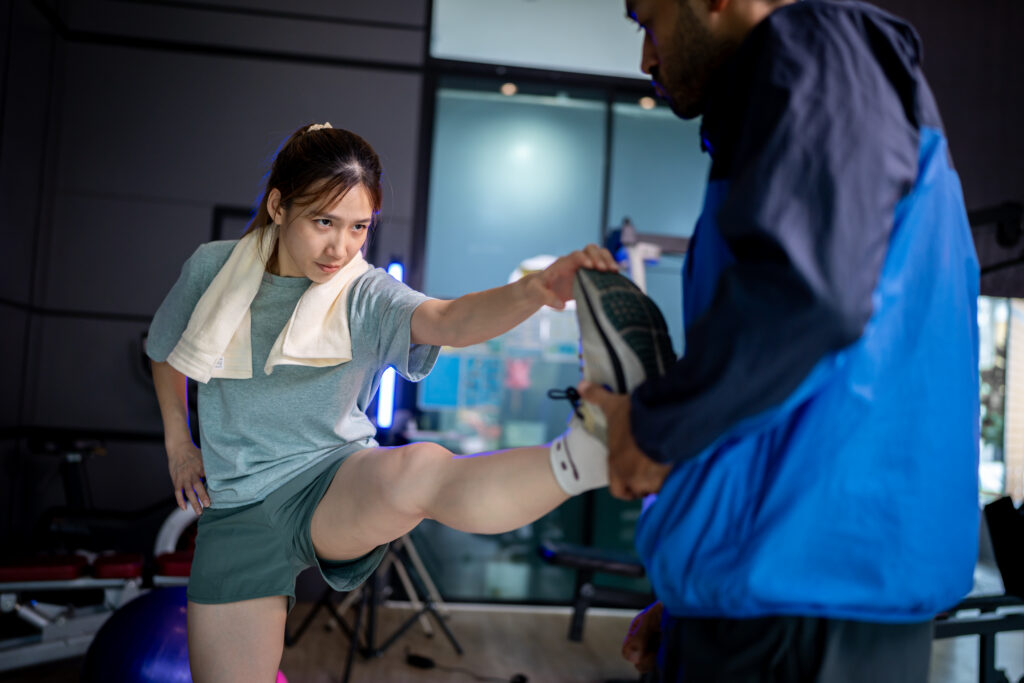
Gait analysis for runners performed by a physical therapist looks beyond the surface and connects the dots between symptoms, strength, mechanics, and training habits.
Identifying Injury-Causing Patterns
Recurring pain usually has a “why.” A PT-led evaluation identifies it.
Instead of treating the sore spot alone, your Ivy Rehab therapist addresses the underlying driver. That’s how you move from short-term relief to long-term durability.
Corrective Strength & Mobility Programs
Weakness, stiffness, or poor motor control often contribute to faulty gait mechanics. A targeted strength training program may include:
- Hip strengthening exercises.
- Ankle mobility work.
- Core stability training.
- Single-leg control drills.
These interventions are selected based on your individual findings, not a generic template. Clinical guidelines consistently support exercise therapy as a core component of managing many running-related injuries.
The right exercises don’t just reduce pain. They build capacity. And capacity is what keeps runners running.
Running Form Cueing & Drills
Sometimes small cues create meaningful change. A slight increase in cadence. A subtle posture adjustment. A reminder to stay tall instead of collapsing late in a run.
These changes are designed to feel natural, not forced. Running should still feel like running, just smoother and more efficient. Your Ivy Rehab sports therapist functions as a coach, translating gait data into real-time cues and corrections you can apply immediately.
Load Management & Training Guidance
Even ideal mechanics can’t outpace poor load management. Mileage spikes, aggressive speed work, or abrupt terrain changes can overwhelm even well-conditioned tissue.
A physical therapist helps structure progression so your training challenges you without sidelining you. Smart load management is a cornerstone of sustainable running injury prevention.
Optimize Your Athletic Performance
Our therapists specialize in helping athletes of all levels return to peak condition.
What a Gait Analysis Looks Like at Ivy Rehab
This evaluation at Ivy Rehab Therapy blends advanced technology with clinical reasoning to give runners a complete picture of their movement patterns. A running gait analysis gives you an objective view of your stride that you simply can’t see on your own.
Your visit may include:
- Video-based running analysis from multiple angles.
- One-on-one assessment with a physical therapist trained in running biomechanics.
- Strength, mobility, and movement control testing.
- A personalized injury prevention plan.
You’ll leave with clarity. Not just data points on a screen, but a plan you understand and can implement with confidence.
Gait Analysis vs Shoe Changes or Online Advice
Footwear plays a role in comfort and preference. The right shoe can complement your mechanics and support your training goals.
But running shoes don’t strengthen weak hips. They don’t improve trunk control. And they can’t retrain inefficient gait mechanics.
Retail gait assessments often focus primarily on foot type and pronation to guide shoe selection. That can be useful when choosing footwear. It doesn’t explain why pain keeps returning.
A PT-led gait analysis for runners evaluates joint loading, muscle control, cadence, stride strategy, and training history. It connects your movement patterns to your symptoms and your goals.
Instead of asking, “Which shoe should I buy?” the better question becomes, “How can I move more efficiently and build resilience?”
It’s not about optimizing the shoe. It’s about optimizing the runner inside it.
Who Benefits Most From Gait Analysis?
You don’t have to be injured to benefit from a movement assessment. In fact, proactive care often produces the best outcomes. Every runner has a unique gait pattern, and understanding yours is the first step toward smarter, more sustainable training.
Gait analysis is especially helpful for:
- New runners building mileage.
- Experienced runners with repeat injuries.
- Athletes returning after time off or rehab.
- Runners increasing speed, distance, or terrain changes.
- Anyone training pain-free but seeking stronger running injury-prevention strategies.
Whether you’re preparing for your first 5K or your tenth marathon, better gait mechanics support long-term durability. And durability is what keeps goals within reach.
Why Choose Ivy Rehab for Running Injury Prevention
Runners don’t just need rest. They need answers.
Ivy Rehab Therapy blends sports physical therapy expertise with runner-specific care. Our approach emphasizes:
- Physical therapists trained in running biomechanics.
- An injury-prevention-first mindset.
- Individualized strength and movement plans.
- Long-term durability, not quick fixes.
We believe in helping you run for years, not just finish the next race. Progress isn’t measured only in finish lines. It’s measured in consistency, confidence, and pain-free miles.
Run Stronger. Run Longer. Stay in the Race.
Running injury prevention starts with how you move. Small mechanical inefficiencies repeated over thousands of steps can quietly increase stress and risk.
Gait analysis for runners helps you understand your unique movement patterns and make smart, sustainable adjustments that protect your body and improve performance.
If you’re dealing with recurring pain, returning from injury, or simply want to run more efficiently, a PT-led evaluation can provide clarity and direction.
Your next personal record is exciting. Staying healthy enough to chase the one after that is even better.
Explore your options. Find a location near you and discover how better movement can support stronger miles ahead.
References
- Vannatta, C.N., Heinert, B.E., & Kernozek, T.W. (2020). Biomechanical risk factors for running-related injury differ by sample population: A systematic review and meta-analysis. Clinical Biomechanics, 76, 104991. https://doi.org/10.1016/j.clinbiomech.2020.104991
- Heiderscheit, B.C., et al. (2011). Effects of step rate manipulation on joint mechanics during running. Medicine & Science in Sports & Exercise, 43(2), 296–302. https://pubmed.ncbi.nlm.nih.gov/20581720/
- American Physical Therapy Association. (2023). Physical Therapy Guide to Shin Splints (Medial Tibial Stress Syndrome). https://www.choosept.com/guide/physical-therapy-guide-shin-splints-medial-tibial-stress-syndrome-

Before you go
Find the right therapy today.
Discover how Ivy Rehab can help you get back to doing what you love.